
Chapter 3 · Eros and Psyche · Philosophy
Diotima’s ladder
Socrates says a woman from Mantinea taught him that Love is a wanting that climbs from one beautiful body to beauty itself.
He is a great spirit (daimon), and like all spirits he is intermediate between the divine and the mortal.
A party, and a teacher Socrates names
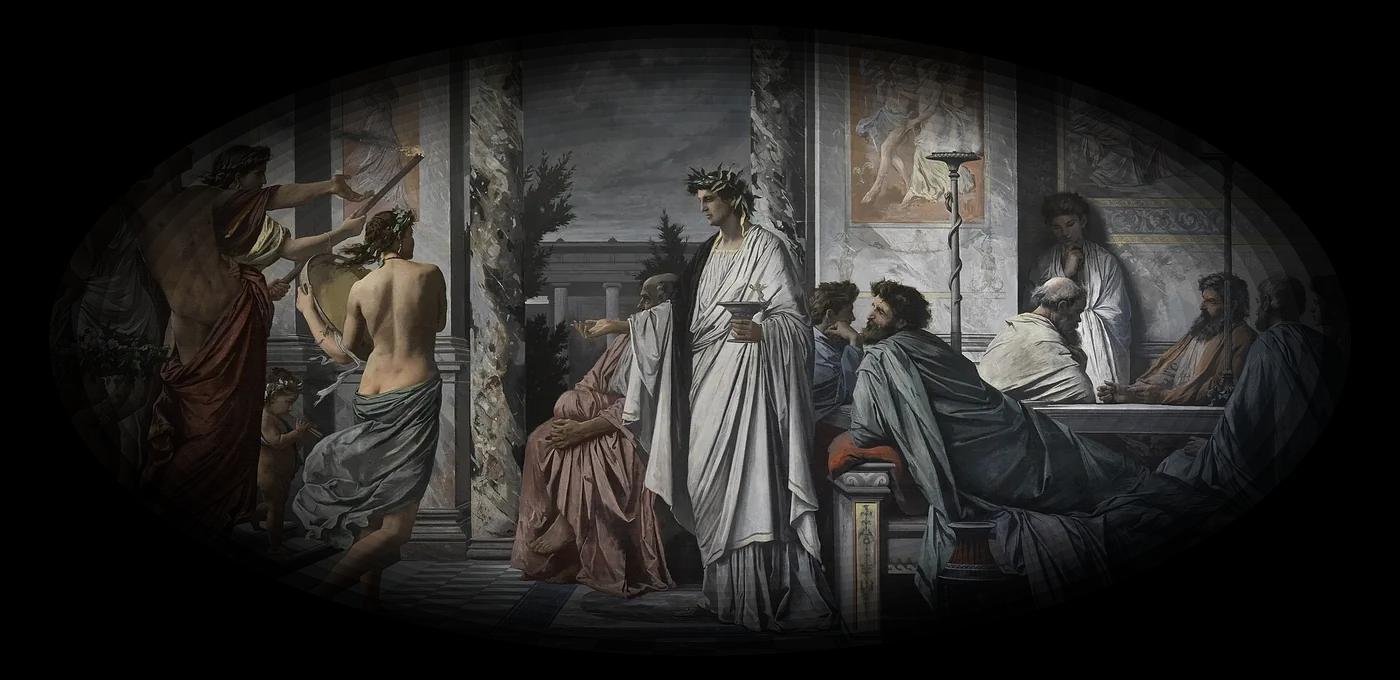
The Symposium is set at a banquet in 416 BC at the house of the tragic poet Agathon, who is celebrating his first victory in a dramatic competition; Apollodorus tells it to a friend, having heard it from Aristodemus, who was there [1]. Each guest speaks in praise of Eros. When Socrates' turn comes he says he will repeat what a woman from Mantinea named Diotima taught him [2].
Diotima may not have existed. Plato's dialogue is the only independent reference to her; scholars have long debated whether she was a real person or an invention of Plato, and most modern scholars think she was invented, and Marsilio Ficino is named as the first to suggest she might be fictional [3]. The page takes no side. It reads her as Plato gives her: a voice that asks Socrates questions until he cannot answer.
Neither a god nor a mortal
Socrates has just argued that Love wants what he lacks. Diotima draws the conclusion: a god who lacked the good and the fair would not be a god, so Love is something in between [2]. According to the summary of the dialogue on Wikipedia, in her account Eros is not a god but a spirit that mediates between humans and what they desire [1].
he is the mediator who spans the chasm which divides them, and therefore in him all is bound together
The child of Poros and Penia
Asked who his parents were, Diotima tells a story. Jowett calls them Poros or Plenty and Penia or Poverty; Wikipedia's article on Diotima gives them as resource (poros) and poverty (penia) [2] [3]. Love is conceived on the birthday of Aphrodite, on the night the beggar lies down beside the sleeper.
What Love inherits is both. He is always poor, and always plotting; he is neither mortal nor immortal, alive when he has plenty and dead when he has none [2]. The drawing below braids two strands, one thin and bare, one full, between the earth and the sky, and lets them settle into one.
On the birthday of Aphrodite there was a feast of the gods, at which the god Poros or Plenty, who is the son of Metis or Discretion, was one of the guests. When the feast was over, Penia or Poverty, as the manner is on such occasions, came about the doors to beg.
Now Plenty who was the worse for nectar (there was no wine in those days), went into the garden of Zeus and fell into a heavy sleep, and Poverty considering her own straitened circumstances, plotted to have a child by him, and accordingly she lay down at his side and conceived Love
In the first place he is always poor, and anything but tender and fair, as the many imagine him; and he is rough and squalid, and has no shoes, nor a house to dwell in
Like his father too, whom he also partly resembles, he is always plotting against the fair and good; he is bold, enterprising, strong, a mighty hunter, always weaving some intrigue or other, keen in the pursuit of wisdom, fertile in resources; a philosopher at all times
He is by nature neither mortal nor immortal, but alive and flourishing at one moment when he is in plenty, and dead at another moment, and again alive by reason of his father’s nature.
Why a lover of wisdom is neither wise nor foolish
The same account gives a reason that philosophy exists at all. A god already has wisdom and an ignorant person feels no want of it, so whoever seeks wisdom stands between the two, and Love is one of those who seek [2]. Diotima also tells Socrates he has confused the lover with the beloved [2].
No god is a philosopher or seeker after wisdom, for he is wise already; nor does any man who is wise seek after wisdom.
For the beloved is the truly beautiful, and delicate, and perfect, and blessed; but the principle of love is of another nature, and is such as I have described.
The ladder
Diotima then describes how a person who loves rightly might be led on. Each step is quoted below in Jowett's words, from one beautiful form to beauty itself. Wikipedia's summary describes it as a movement from earthly beauty, or beautiful bodies, to beautiful souls [3].
Press Climb to take one rung at a time, Step down to go back, or use the arrow keys when the ladder has focus. The picture widens as the reach does: a single figure, a crowd, a sea of light.
Rung 1 of 7: One beautiful body
For he who would proceed aright in this matter should begin in youth to visit beautiful forms; and first, if he be guided by his instructor aright, to love one such form only—out of that he should create fair thoughts
Rung 1 of 7: One beautiful body. For he who would proceed aright in this matter should begin in youth to visit beautiful forms; and first, if he be guided by his instructor aright, to love one such form only—out of that he should create fair thoughts
All seven rungs, in order
For he who would proceed aright in this matter should begin in youth to visit beautiful forms; and first, if he be guided by his instructor aright, to love one such form only—out of that he should create fair thoughts
Diotima, as Socrates reports her (Plato, Symposium), Symposium 210a. Symposium, tr. Jowett And when he perceives this he will abate his violent love of the one, which he will despise and deem a small thing, and will become a lover of all beautiful forms
Diotima, as Socrates reports her (Plato, Symposium), Symposium 210b. Symposium, tr. Jowett in the next stage he will consider that the beauty of the mind is more honourable than the beauty of the outward form.
Diotima, as Socrates reports her (Plato, Symposium), Symposium 210b. Symposium, tr. Jowett until he is compelled to contemplate and see the beauty of institutions and laws, and to understand that the beauty of them all is of one family, and that personal beauty is a trifle
Diotima, as Socrates reports her (Plato, Symposium), Symposium 210c. Symposium, tr. Jowett and after laws and institutions he will go on to the sciences, that he may see their beauty
Diotima, as Socrates reports her (Plato, Symposium), Symposium 210c. Symposium, tr. Jowett drawing towards and contemplating the vast sea of beauty, he will create many fair and noble thoughts and notions in boundless love of wisdom
Diotima, as Socrates reports her (Plato, Symposium), Symposium 210d. Symposium, tr. Jowett beauty absolute, separate, simple, and everlasting, which without diminution and without increase, or any change, is imparted to the ever-growing and perishing beauties of all other things.
Diotima, as Socrates reports her (Plato, Symposium), Symposium 211a–b. Symposium, tr. Jowett
to begin from the beauties of earth and mount upwards for the sake of that other beauty, using these as steps only
But what if man had eyes to see the true beauty—the divine beauty, I mean
bringing forth and nourishing true virtue to become the friend of God and be immortal, if mortal man may. Would that be an ignoble life?
Questions to carry
- If love begins in wanting, can it ever stop wanting without ceasing to be love?
- Does the ladder leave each rung behind, or carry it up?
- Whose voice is it when a teacher who may be invented tells a philosopher what love is?
Sources and notes
- [1] Wikipedia: Symposium (Plato)Reference. Symposium (Plato). Wikipedia, revision 1386295514.
- [2] Symposium, tr. JowettPrimary source. Plato, Symposium, translated by Benjamin Jowett. Project Gutenberg eBook #1600.
- [3] Wikipedia: Diotima of MantineaReference. Diotima of Mantinea. Wikipedia, revision 1360703683.
Picture credits
- Das Gastmahl des Platon (Plato's Symposium), Anselm Feuerbach, 1869 (Staatliche Kunsthalle Karlsruhe). Anselm Feuerbach, 1869. Public domain (artist died 1880). Changed: resized and softly vignetted. Commons file page