
Ways of living · A series
Eros and Psyche
A search through ten questions about love and the soul.
In the Symposium, Socrates reports a teacher who says that love is not a god but a wanting: it reaches for what it lacks [1]. The Greek word for the soul, psyche, is also the word for a butterfly [2]. Ten chapters follow one question each, from the oldest stories to the newest, and none of them answers it for you. Two are open now.
This is a search, so each chapter ends on questions and leaves the answers open. Where a reader of the old stories is named, it is that reader's view and not this page's.
And you admitted that Love, because he was in want, desires those good and fair things of which he is in want?
The ten chapters
Two are open. The other eight are marked coming, each with the question it will ask.
Myth
Chapter 1 · Coming
Before the gods
What was there before the gods, and was Love already there?
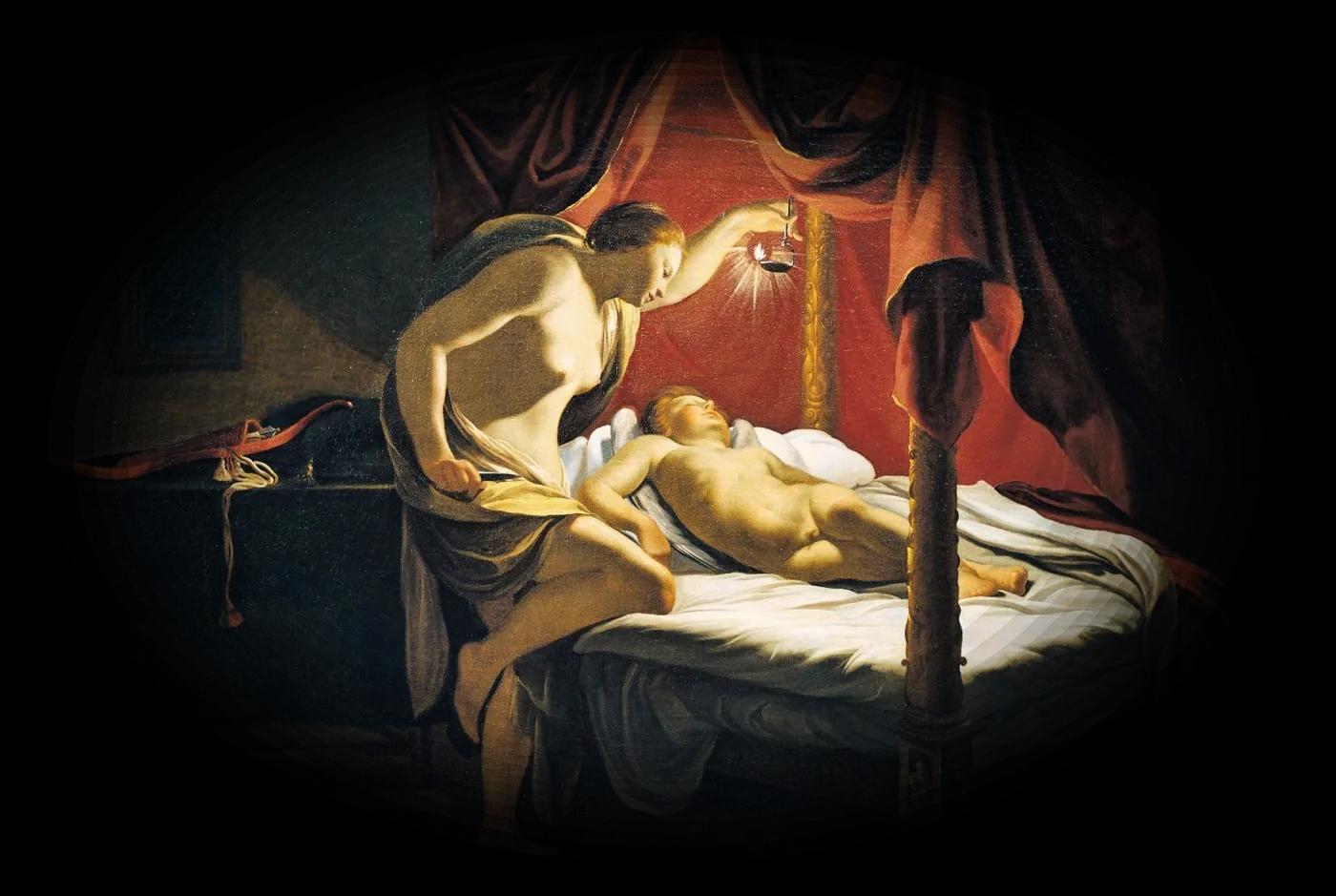
Chapter 5 · Open
The lamp
What happens to love when it is looked at in the light?
Philosophy
Chapter 2 · Coming
The split humans
Are we each half of something, looking for the other half?
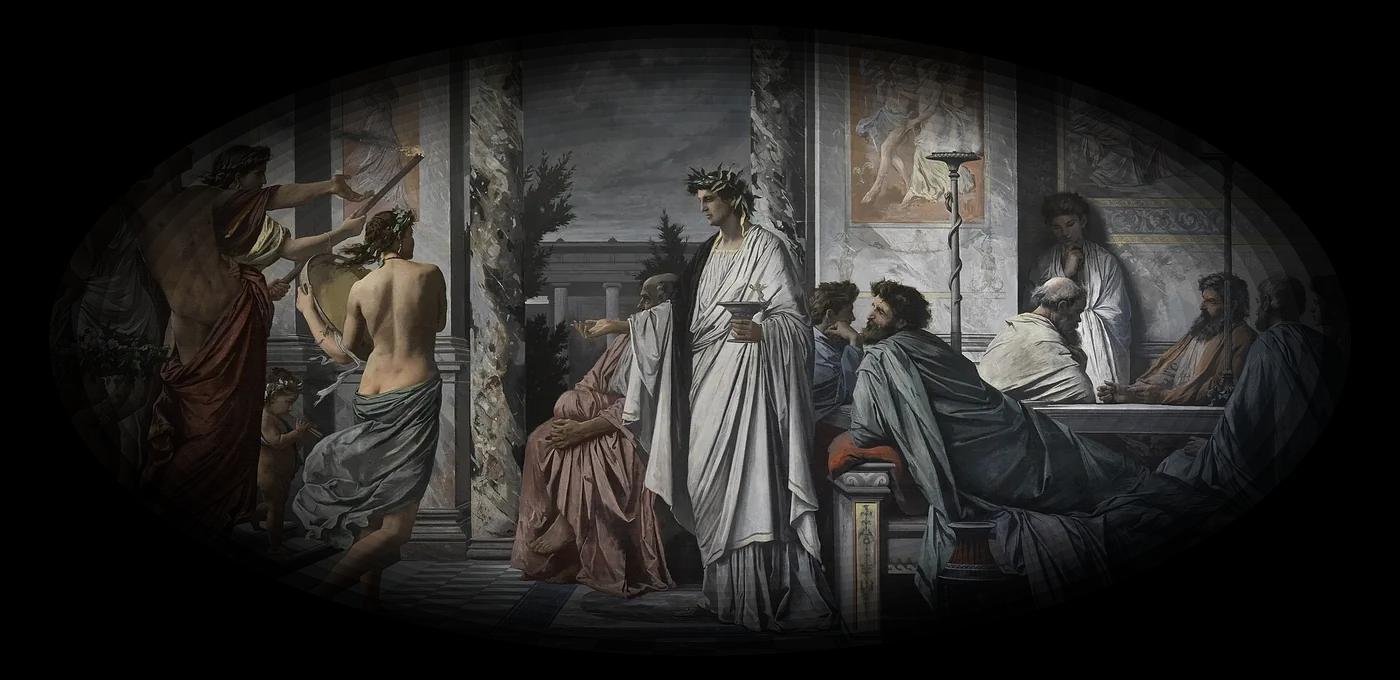
Chapter 3 · Open
Diotima’s ladder
If love is a wanting, what is it we want, and where does the wanting lead?
Chapter 4 · Coming
The winged soul
What would it take for a soul to grow wings?
Religion
Chapter 7 · Coming
Eros and agape
Is wanting love and giving love the same thing, or two?
Chapter 8 · Coming
The soul as bride
Why did mystics reach for the language of a wedding?
Readers and moderns
Chapter 6 · Coming
Reading the myth
Why did so many readers hear a story about the soul in a story about a girl and a god?
Chapter 9 · Coming
Platonic love
What did anyone mean by love without touching?
Chapter 10 · Coming
The moderns
How does the old question sound after Freud, Rollo May and Anne Carson?
The bookshelf
Plain jackets: where each chapter will start reading.
As an Amazon Associate I earn from qualifying purchases.
Symposium
Plato
The dialogue where Diotima speaks. This page quotes the free Jowett translation. [3]
Buy on AmazonPhaedrus
Plato
The winged soul and divine madness, for chapter 4. [4]
Buy on AmazonThe Golden Ass
Apuleius
A modern translation by E. J. Kenney; the page quotes Adlington instead, which is free. [5]
Buy on AmazonAmor and Psyche
Erich Neumann
A modern reading of the myth, for chapter 6. Not quoted here. [6]
Buy on AmazonTill We Have Faces
C. S. Lewis
A retelling from the point of view of Psyche’s sister, for chapter 6. Not quoted here. [7]
Buy on AmazonEros the Bittersweet
Anne Carson
An essay on desire as lack, for chapter 10. Not quoted here. [8]
Buy on Amazon
Sources and notes
- [1] Symposium, tr. JowettPrimary source. Plato, Symposium, translated by Benjamin Jowett. Project Gutenberg eBook #1600.
- [2] Wikipedia: Psyche (mythology)Reference. Psyche (mythology). Wikipedia, revision 1383477407.
- [3] Symposium (Hackett)Book edition. Plato, Symposium, Hackett Publishing Company, 2003, ISBN-10 0872200760.
- [4] Phaedrus (Hackett)Book edition. Plato, Phaedrus, Hackett Publishing Company, 2005, ISBN-10 0872202208.
- [5] The Golden Ass (Penguin)Book edition. Apuleius, The Golden Ass, or, Metamorphoses, translated by E. J. Kenney, Penguin Books, 1998, ISBN-10 0140435905.
- [6] Amor and Psyche (Princeton)Book edition. Erich Neumann, Amor and Psyche, Princeton University Press, 1971, ISBN-10 0691017727.
- [7] Till We Have Faces (Harcourt)Book edition. C. S. Lewis, Till We Have Faces, Harcourt, 1956, ISBN-10 0156904365.
- [8] Eros the Bittersweet (Dalkey)Book edition. Anne Carson, Eros the Bittersweet, Dalkey Archive Press, 1998, ISBN-10 1564781887.
Picture credits
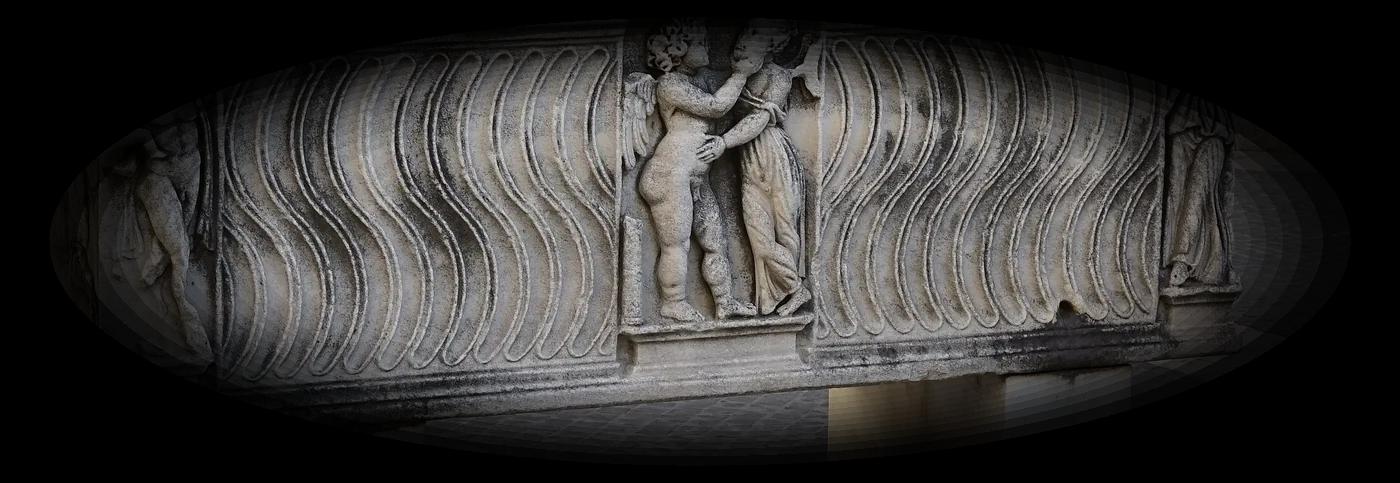
- Strigillated sarcophagus with Eros and Psyche, Roman, 3rd century AD (Vatican Museums, Pio Clementino, inv. 17876). Roman workshop; photograph by Fabrizio Garrisi, 3rd century AD (photograph 2022). CC BY-SA 4.0. Changed: cropped, resized, softly vignetted and recompressed (WebP); shared under the same licence. Commons file page
- Das Gastmahl des Platon (Plato's Symposium), Anselm Feuerbach, 1869 (Staatliche Kunsthalle Karlsruhe). Anselm Feuerbach, 1869. Public domain (artist died 1880). Changed: resized and softly vignetted. Commons file page
- Psyché et l'Amour, Simon Vouet. Simon Vouet, between 1626 and 1629. Public domain (artist died 1649). Changed: cropped, resized and softly vignetted. Commons file page
- Psyche Carried Off by the Zephyrs, Pierre-Paul Prud'hon, c. 1800. Pierre-Paul Prud'hon, c. 1800. Public domain (artist died 1823). Changed: resized and softly vignetted. Commons file page