
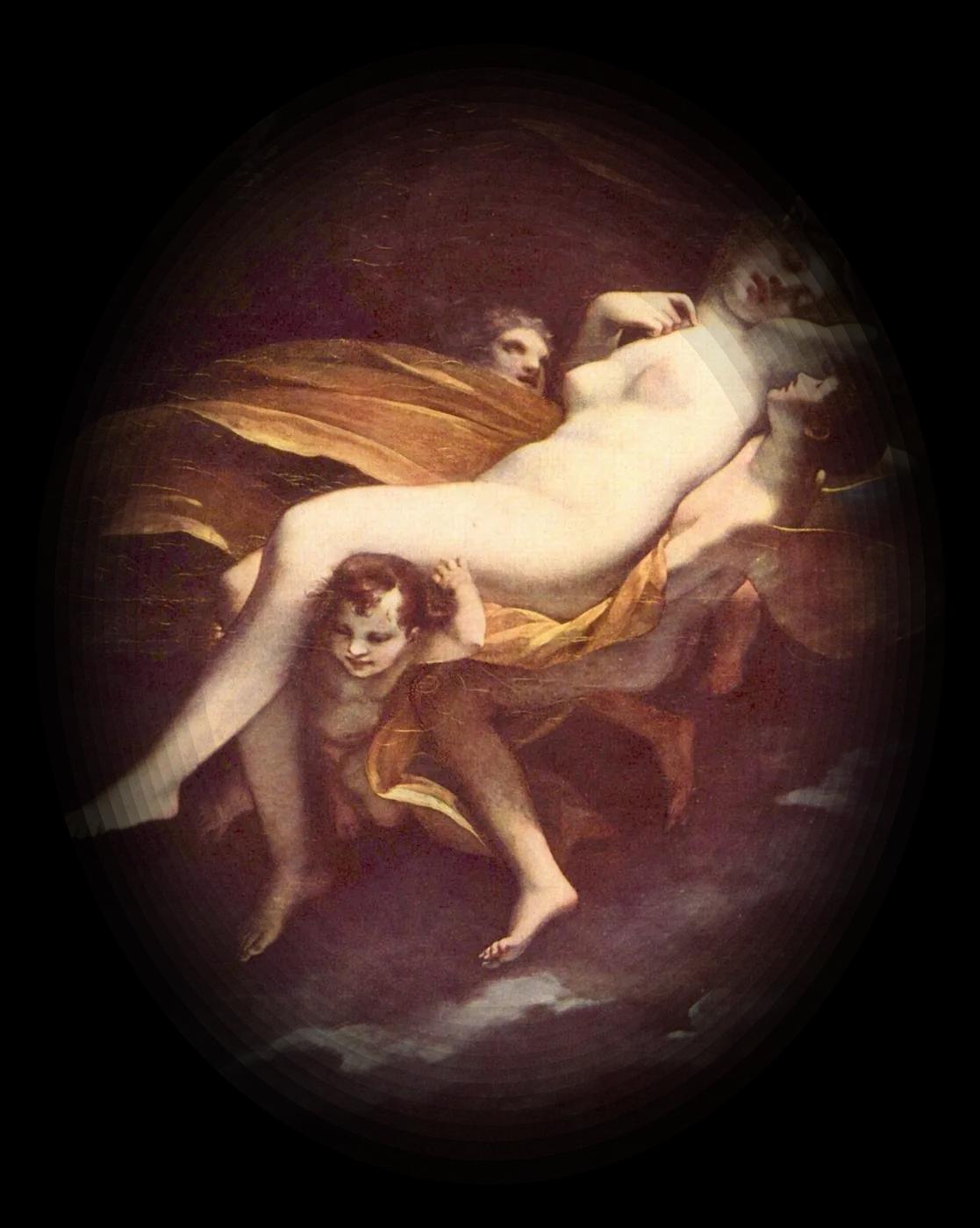
Chapter 5 · Eros and Psyche · Myth
The lamp
The tale of Cupid and Psyche in Apuleius, told in ten stations in Adlington’s 1566 English, with a lamp that reveals and a drop of oil that does not forgive.
she saw the most meeke and sweetest beast of all beasts, even faire Cupid couched fairly, at whose sight the very lampe encreased his light for joy, and the razor turned his edge.
A Platonist tells a story
The tale is told inside a novel, The Golden Ass or Metamorphoses, by Apuleius, a Latin writer of the second century who is described as a Platonist philosopher and who also wrote an outline of Plato's doctrine [1]. Cupid and Psyche sits at the midpoint of the novel and fills about a fifth of it; an old woman tells it to a kidnapped bride [2].
Wikipedia, citing a modern scholar, says the tale resists being read as a strict allegory of any one Platonic argument, but that Apuleius drew generally on imagery such as the winged soul's climb in the Phaedrus and the soul's union with the divine through the daemon Love in the Symposium [2]. That is one reader's view and a hedged one. The question this chapter keeps open is whether a story can say what an argument cannot.
The words below are William Adlington's, from 1566, in the spelling of the 1639 reprint [3]. His is a free version and, Wikipedia notes, it plays down the sensuality of the Latin [2]. Psyche's name is the Greek word for soul and for butterfly [4].
Station 1: the jealous Venus
A king's youngest daughter is so beautiful that people begin to worship her in place of Venus. Venus, insulted, sends her son Cupid to make the girl fall in love with the most wretched creature alive [3] [2].
I pray thee (quoth she) my dear childe, by motherly bond of love, by the sweet wounds of thy piercing darts, by the pleasant heate of thy fire, revenge the injury which is done to thy mother by the false and disobedient beauty of a mortall maiden
Station 2: the cliff and the West Wind
No suitor comes. An oracle tells her father to dress her for a funeral and leave her on a crag, and her husband will be no mortal. Zephyrus, the West Wind, carries her down to a meadow [3] [2].
Thus poore Psyches being left alone, weeping and trembling on the toppe of the rocke, was blowne by the gentle aire and of shrilling Zephyrus, and carried from the hill with a meek winde, which retained her garments up
Station 3: the invisible palace
She finds a palace with no locks, served by voices with no bodies. At night her husband comes to her in the dark and leaves before dawn [3].
she heard a voyce without any body, that sayd, Why doe you marvell Madame at so great riches? behold, all that you see is at your commandement
Station 4: the sisters
Her envious sisters visit and persuade her that the husband she has never seen is a monster. They give her a plan: a razor, and a lamp hidden in the room [3].
Take a sharpe razor and put it under the pillow of your bed; and see that you have ready a privy burning lampe with oyle, hid under some part of the hanging of the chamber
Station 5: the lamp and the drop of oil
In the dark chamber below, raise the lamp. A warm cone of light finds a sleeping, winged form, drawn here as plain geometric line and not copied from any painting. Then, as in the tale, a drop of burning oil falls [3].
The chamber is dark. Someone is asleep in it.
The chamber is dark. Someone is asleep in it.
there fell out a droppe of burning oyle from the lampe upon the right shoulder of the god. O rash and bold lampe, the vile ministery of love, how darest thou bee so bold as to burne the god of all fire?
Station 6: the flight
Cupid wakes, burnt, and flies out of the window. Psyche clings to his thigh until she falls, and he speaks to her from a cypress before he is gone [3].
As for thee thou shalt be sufficiently punished by my absence. When hee had spoken these words he tooke his flight into the aire.
Station 7: the four tasks
Psyche goes to Venus, who sets her tasks. In the tale she sorts a heap of grains, gathers golden wool, fills a flask with the water of the Styx, and takes a box to the underworld, and each of the first three is done with help she does not expect [3] [2]. The four small panels move on their own; the lines are Adlington's.
The seeds and the ants
Then the little pismire the emote, taking pitty of her great difficulty and labour, cursing the cruellnesse of the daughter of Jupiter, and of so evill a mother, ran about, hither and thither, and called to all her friends
The golden fleece
there be great sheepe shining like gold, and kept by no manner of person. I command thee that thou go thither and bring me home some of the wooll of their fleeces.
The water of the Styx
Seest thou the toppe of yonder great Hill, from whence there runneth downe waters of blacke and deadly colour, which nourisheth the floods of Stix, Cocytus?
The box from Proserpina
Take this box and to Hell to Proserpina, and desire her to send me a little of her beauty, as much as will serve me the space of one day
Then the little pismire the emote, taking pitty of her great difficulty and labour, cursing the cruellnesse of the daughter of Jupiter, and of so evill a mother, ran about, hither and thither, and called to all her friends
there be great sheepe shining like gold, and kept by no manner of person. I command thee that thou go thither and bring me home some of the wooll of their fleeces.
Seest thou the toppe of yonder great Hill, from whence there runneth downe waters of blacke and deadly colour, which nourisheth the floods of Stix, Cocytus?
Take this box and to Hell to Proserpina, and desire her to send me a little of her beauty, as much as will serve me the space of one day
Station 8: the descent and the box
She is told not to open the box, and does, hoping to borrow some beauty for Cupid's sake. Inside is a deadly sleep [3].
And by and by shee opened the boxe where she could perceive no beauty nor any thing else, save onely an infernall and deadly sleepe, which immediatly invaded all her members as soone as the boxe was uncovered
Station 9: Jupiter’s wedding
Cupid wakes her, and takes his case to Jupiter, who calls the gods together, gives Psyche the drink of immortality and holds a wedding banquet [3] [2].
And then he tooke a pot of immortality, and said, Hold Psyches, and drinke, to the end thou maist be immortall, and that Cupid may be thine everlasting husband.
Station 10: their daughter
The story ends with a child. Adlington calls her Pleasure; Wikipedia gives her Latin name as Voluptas, and the Greek Hedone [3] [2].
and thus Psyches was married to Cupid, and after she was delivered of a child whom we call Pleasure.
Questions to carry
- Does Psyche lose Cupid because she looked, or because she doubted before she looked?
- Why does the story need four impossible tasks between the lamp and the wedding?
- If the soul is the one who wanders, who is the one who flies away?
Sources and notes
- [1] Wikipedia: ApuleiusReference. Apuleius. Wikipedia, revision 1385556155.
- [2] Wikipedia: Cupid and PsycheReference. Cupid and Psyche. Wikipedia, revision 1385984377.
- [3] The Golden Asse, tr. Adlington (Gutenberg)Primary source. Apuleius, The Golden Asse, translated by William Adlington (1566), as reprinted from the edition of 1639 with its spelling kept. Project Gutenberg eBook #1666.
- [4] Wikipedia: Psyche (mythology)Reference. Psyche (mythology). Wikipedia, revision 1383477407.
Picture credits
- Psyche Carried Off by the Zephyrs, Pierre-Paul Prud'hon, c. 1800. Pierre-Paul Prud'hon, c. 1800. Public domain (artist died 1823). Changed: resized and softly vignetted. Commons file page