
Ways of living · One long page
Viktor Frankl and Man's Search for Meaning
Viktor Frankl (1905-1997) was a Vienna psychiatrist who survived the camps and founded logotherapy [1] [2]. In 1946 he dictated Man's Search for Meaning in nine days [2]. This page sets out his life in a short timeline, then eight ideas from the book, one station at a time. The book is still in copyright, so each station carries one short quotation and the rest is the page's own summary.
et lux in tenebris lucetIn the book, Frankl is at work in a trench at dawn when a light comes on in a distant farmhouse, and he gives the Latin line above [3] [4].
Part one His life, in order
1905
Vienna
Born in Vienna
Viktor Emil Frankl was born in Vienna on 26 March 1905, the second of three children; his father was a director in the Ministry of Social Service [2]. As a schoolboy he went to public lectures on psychology and wrote to Sigmund Freud, and at fifteen gave a first public lecture, "On the Meaning of Life" [2]. In 1927 he was excluded from Alfred Adler's circle after disagreeing with him [2].
1928-1937
Vienna
Counselling young people, and the suicide ward
From 1928 he organised youth counselling centres in Vienna, and in 1930 a special counselling effort at the end of the school term, after which the Institute says the number of student suicides fell significantly [2]. Wikipedia adds that in 1931 not a single Viennese student died by suicide [1]. From 1933 to 1937 he was chief doctor of the women's suicide pavilion at the Steinhof psychiatric hospital, seeing about 3,000 patients a year [2].
1938-1941
Vienna
After the annexation
After Austria was annexed by Nazi Germany in March 1938 his work as a doctor was limited [1]. In 1940 he became head of the neurology department of the Rothschild Hospital, the only Vienna hospital still admitting Jews, and the Institute says he made false diagnoses to keep patients from the Nazi euthanasia programme [2] [1]. He had an immigration visa to the United States and let it lapse, so as not to leave his parents [2]. In 1941 he married Tilly Grosser, a nurse at the hospital [1].
1942
Theresienstadt
Theresienstadt
In September 1942 Frankl, Tilly and his parents were deported to the Theresienstadt ghetto, north of Prague [2]. His father died there on 13 February 1943 [1]. The Institute says Frankl organised a first-response team for new arrivals who were in shock, working against the danger of suicide [2].
1944
Auschwitz, Kaufering and Türkheim
Auschwitz, then Kaufering and Türkheim
In 1944 Frankl and Tilly, and soon after his mother, were taken to Auschwitz-Birkenau; the Institute says his mother was murdered at once and that Tilly was moved to Bergen-Belsen [2]. It says that after a few days he was selected for a labour camp, and was taken to Kaufering and later Türkheim, subsidiary camps of Dachau in Bavaria [2]. Wikipedia reports that the historian Timothy Pytell argues he was at Auschwitz for no more than a few days and that most of what the book describes took place at Kaufering III, and that the director of the Viktor Frankl Institute disputes Pytell's work [1]. The Institute says that on arriving at Auschwitz-Birkenau he was forced to throw away the unpublished manuscript of his first book [2].
1945
Türkheim
Liberation, and the news
At Türkheim he fell ill with typhoid fever, and the Institute says he kept himself awake at night by rewriting his lost manuscript on scraps of paper [2]. US troops liberated the camp on 27 April 1945 [2]. He went back to Vienna and learned within days of the deaths of Tilly, his mother and his brother Walter [2]. Wikipedia says that Tilly died of typhus at Bergen-Belsen [1]. His sister Stella, who had gone to Australia, survived [1].
1946
Vienna
The book, in nine days
In 1946 he dictated a book in nine days, Ein Psycholog erlebt das Konzentrationslager ("A Psychologist Experiences the Concentration Camp"), published in German that year [2] [5]. The first English edition, in 1959, was titled From Death-Camp to Existentialism; it became Man's Search for Meaning [5]. That year, the Institute says, he also became director of the Vienna neurological polyclinic, a post he held for 25 years [2].
1946-1997
Vienna
Logotherapy, and the years after
He remarried in 1947 and had a daughter [2]. Logotherapy, which he first described in 1926, became known as a third Viennese school after Freud's and Adler's [2]. In a 1991 survey for the Library of Congress and the Book of the Month Club the book was named one of the ten most influential books in the United States [5]. He died of heart failure in Vienna on 2 September 1997 [2] [1]. Critics, among them Lawrence Langer and Timothy Pytell, have challenged parts of his account and of his later positions, and Wikipedia gives their arguments and the replies [1].
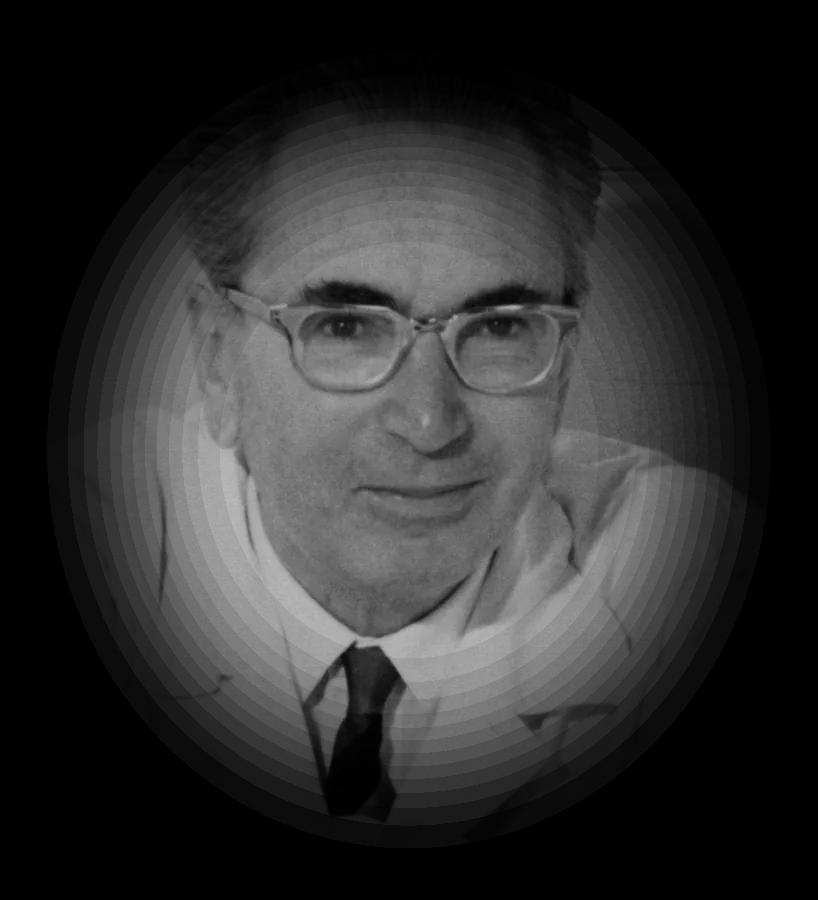
Viktor Frankl, 1965. Credit in the notes.
Part two The book, in eight stations
I Station 1 of 8
The last of the human freedoms
Taken away: 0 of 4.
…everything can be taken from a man but one thing: the last of the human freedoms—to choose one’s attitude in any given set of circumstances, to choose one’s own way.
Almost everything a person has can be taken, and the book says one thing cannot.
Frankl describes arriving at a camp and having what he owned taken [3] [4]. The Institute says he was forced to throw away the unpublished manuscript of his first book [2], and Wikipedia says he had hidden it in the lining of his jacket [1]. From such losses the book argues that a prisoner could still decide how to meet them, and it points to men who comforted others in the huts and shared what little they had [3] [4]. Frankl does not say that this was easy or that everyone could, only that the choice was there to be made, day after day [3] [4].
II Station 2 of 8
A why
The star is in view: the lines hold.
Hat man sein warum? des Lebens, so verträgt man sich fast mit jedem wie?
This page's own rendering: If you have your why of life, you can put up with almost any how.
Someone who knows what they live for can bear a great deal of how.
Frankl quotes this line of Nietzsche's in English in Part One, calling it a guiding motto for any effort to strengthen prisoners [3] [4]. He writes that the prisoner who saw no sense in his life and no aim was soon lost, and that the work of the doctor was to give such men a why [3] [4]. The German is Nietzsche's, from Götzen-Dämmerung; this page checks it against two editions, which print it with a lower-case "warum" and "wie" [6] [7]. The English beside it is this page's own, not Frankl's.
III Station 3 of 8
Love
The lights are some way apart. The thread between them holds.
The salvation of man is through love and in love.
In the dark, on a march, the book holds that love is not cancelled by distance.
The book has a march to a work site in the dark before dawn, each man thinking of his wife [3] [4]. Frankl writes that he held an inner conversation with his wife, that he did not know whether she was alive and had no way to find out, and that during that march the question lost its weight for him [3] [4]. He came to learn after liberation that she had died [2] [1]. The passage is the book's case that love reaches the person himself, not only the body, and is the reason this figure shows two lights joined by a line whatever the gap.
IV Station 4 of 8
Three paths to meaning
Choose one of the three.
…we can discover this meaning in life in three different ways: (1) by creating a work or doing a deed; (2) by experiencing something or encountering someone; and (3) by the attitude we take toward unavoidable suffering.
A deed, an encounter and a way of meeting what cannot be changed.
Part Two sets out what Frankl calls logotherapy in a short form [3] [4]. Wikipedia summarises its three ways to meaning as making a difference in the world, having particular experiences, and adopting particular attitudes [1]. The book's own sentence is the quotation above. It says the first, the way of achievement, is obvious, and that the second includes love, and the third needs most explaining [3] [4].
V Station 5 of 8
The provisional existence
Step 1 of 5. The way ahead is not shown.
A man who could not see the end of his “provisional existence” was not able to aim at an ultimate goal in life.
A path with no visible end: the book's account of what that did to the men on it.
Frankl writes that a prisoner could not know whether or when his time in the camp would end, and that a man who lost faith in his future was, in his words, doomed [3] [4]. As the book tells it, his senior block warden told him of a dream he had had in February 1945, in which a voice said the war would be over for him on 30 March [3] [4]. The man fell ill on 29 March, was delirious on the 30th and died on 31 March [3] [4]. The book says that he outwardly died of typhus and that Frankl believed the loss of hope had lowered his body's resistance [3] [4]. That reading is Frankl's, as a doctor, and the page reports it as his.
VI Station 6 of 8
The calendar and the granary
Days kept: 0 of 30. Sheets left: 30.
Having been is also a kind of being, and perhaps the surest kind.
Days gone are not days lost: having been is a kind of being.
Part Two says that logotherapy, which keeps in mind that human life is passing, is not pessimistic but "activistic" [3] [4]. It gives a picture: the pessimist watches his wall calendar get thinner as he tears off a sheet each day, while the man who meets life actively files each sheet away, with a few notes written on the back, and can look back on what is kept [3] [4]. This page's figure draws that picture, and its counter is the days kept. The quotation above is from Part One, from the speech he writes that he gave to men in a hut in the dark [3] [4].
VII Station 7 of 8
Tragic optimism
0 of 3 turned.
…an optimism in the face of tragedy and in view of the human potential…
Pain, guilt and death are real, and the book names what each can still become.
The 1984 postscript starts from what logotherapy calls the tragic triad, which it lists as pain, guilt and death [3] [4]. A tragic optimism, he writes, stays hopeful in spite of all three, and he names what each can still become: suffering can be made into something achieved, guilt into a reason to change, and the passing of life into a reason to act responsibly [3] [4]. He adds that optimism is not something that can be ordered into existence [3] [4]. The tiles show those three turns.
VIII Station 8 of 8
The Statue of Responsibility
The plinth is empty and dark.
That is why I recommend that the Statue of Liberty on the East Coast be supplemented by a Statue of Responsibility on the West Coast.
Liberty on the East Coast, and a plinth waiting on the West.
The Institute says that Frankl made this remark in 1961 while a guest professor at Harvard [2]. In the book it closes an argument that freedom without responsibility tends to slide into arbitrariness [3] [4]. Wikipedia reports that Stephen Covey and Kevin Hall later pushed for such a statue, that the sculptor Gary Lee Price designed it as two clasped hands, that Utah approved a site in 2023, and that a different, 15-foot statue with that title was unveiled at Alliant International University on 6 June 2025 [1]. The plinth in the figure is empty.
The bookshelf
Four of his books, in plain jackets. The first is the one on this page.
As an Amazon Associate I earn from qualifying purchases.
Man's Search for Meaning
First published 1946 · Beacon Press, 2006
The book on this page. Part One his experiences; Part Two logotherapy; the 1984 postscript on tragic optimism.
Buy on AmazonYes to Life: In Spite of Everything
First published 1946 · Beacon Press, 2020
Lectures he gave in Vienna in 1946, according to the Institute, published as a book in English in 2020.
Buy on AmazonThe Doctor and the Soul
First published 1946 · Vintage, 2019
His first book on logotherapy; he rebuilt the manuscript he lost at Auschwitz.
Buy on AmazonThe Unheard Cry for Meaning: Psychotherapy and Humanism
First published 2011 · Simon & Schuster, 2011
Listed in the bibliography of the Wikipedia article.
Buy on Amazon
Notes and picture credits
Notes and sources
- [1] Wikipedia: Viktor FranklReference. Viktor Frankl. Wikipedia, revision 1379640117.
- [2] Viktor Frankl Institute Vienna: BiographyPrimary source. "Viktor Emil Frankl", Biography, Viktor Frankl Institute Vienna (viktorfrankl.org), a dated timeline. Read 2026-11-23.
- [3] Viktor E. Frankl, Man's Search for Meaning, tr. Ilse Lasch, Beacon Press, 4th ed. 1992Primary source. Viktor E. Frankl, Man's Search for Meaning: An Introduction to Logotherapy, Part One translated by Ilse Lasch, Beacon Press, Boston, fourth edition 1992 (Parts One and Two and the 1984 Postscript, "The Case for a Tragic Optimism"). In copyright; cited by edition, not linked.
- [4] Viktor E. Frankl, Man's Search for Meaning, Washington Square Press, 1985Primary source. Viktor E. Frankl, Man's Search for Meaning, the Beacon Press translation, Washington Square Press (Pocket Books), first printing February 1985, with the 1984 Postscript. In copyright; cited by edition, not linked.
- [5] Wikipedia: Man's Search for MeaningReference. Man's Search for Meaning. Wikipedia, revision 1384880218.
- [6] Nietzsche, Werke vol. 8 (Leipzig 1896, Internet Archive)Primary source. Friedrich Nietzsche, Werke, vol. 8 (Der Fall Wagner; Götzen-Dämmerung; ...), Leipzig 1896. A scan on the Internet Archive; Nietzsche died in 1900. Götzen-Dämmerung, "Sprüche und Pfeile" 12.
- [7] Nietzsche, Gesammelte Werke vol. 17 (Musarion, Munich 1920, Internet Archive)Primary source. Friedrich Nietzsche, Gesammelte Werke, vol. 17, ed. Richard Oehler and others, Musarion Verlag, Munich 1920. A scan on the Internet Archive. Götzen-Dämmerung, "Sprüche und Pfeile" 12.
- [8] Quote Investigator: "Between Stimulus and Response There Is a Space"Reference. "Quote Origin: Between Stimulus and Response There Is a Space. In That Space Is Our Power To Choose Our Response", Quote Investigator, posted 18 February 2018, updated 23 March 2025. Read 2026-11-23.
Pictures
- Viktor Frankl, 1965, Prof. Dr. Franz Vesely, 1965. Licence: CC BY-SA 3.0 de. Modified: converted to grayscale, darkened and vignetted for this page. Source: Wikimedia Commons.
- The field, the light and the figures are drawn for this page. There are no photographs of camps or of people in them, on purpose.