Chapter 24 · agent-neuron · Lab
The lab, at night
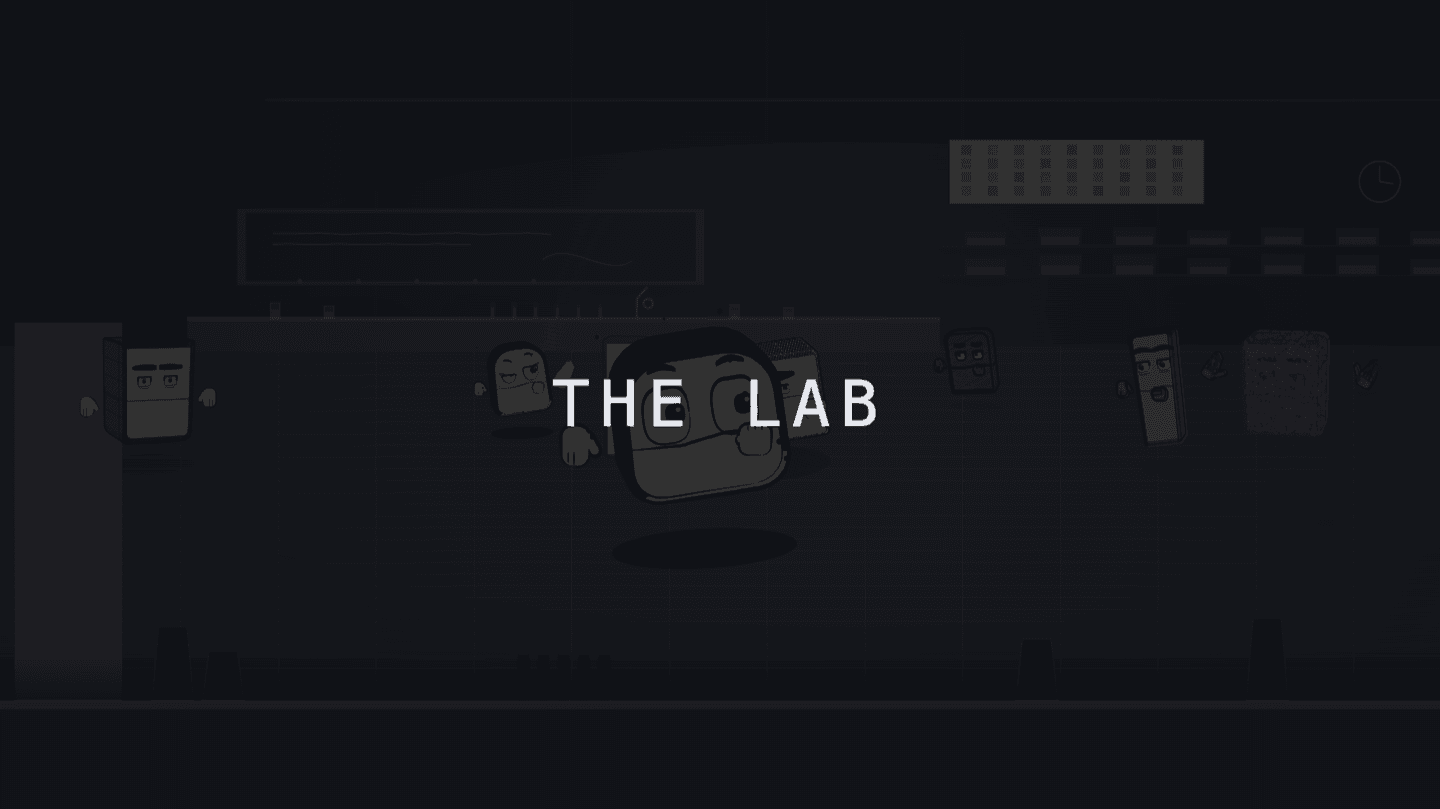
Eight characters and one question on a blackboard: a run’s trace compiled to a film in a room drawn in the stage’s own perspective, a network that lights up as the lines are spoken, and a skin for every scientist.
The scene
A question goes into a room: whether a famous conjecture about where a function’s zeros live is true, or only very well tested. Nobody waits their turn. Seven characters answer it in their own words, and a source speaks first. The run stops when the conversation dies out, which it does.
What the stage does with that run is the whole of this chapter: every answer becomes a line and a face, the camera cuts to whoever is talking, a bubble hangs over their head, and the film ends on the title. The trace is the script; nothing on the page is a live run.
A room, in the stage’s perspective
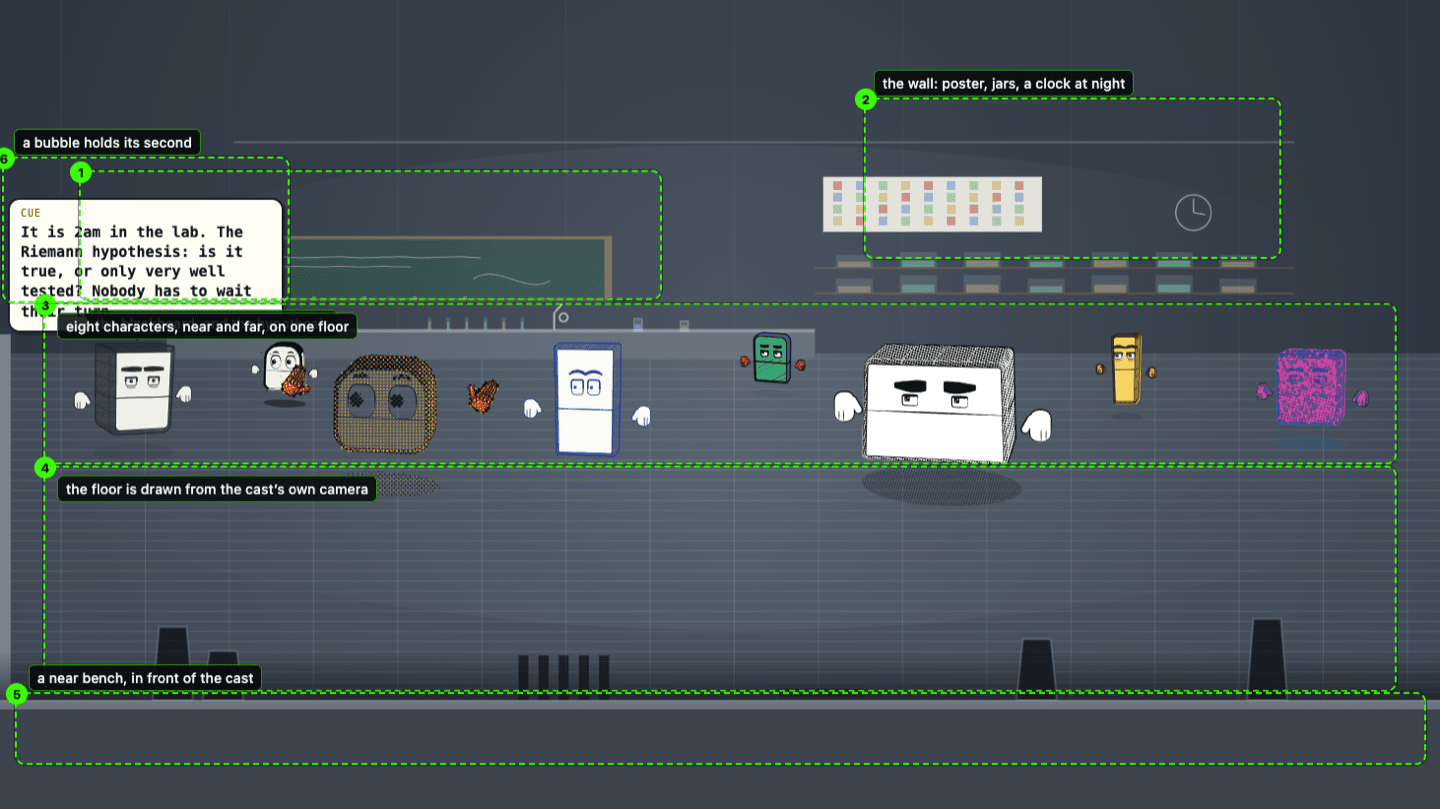
The lab is a room rather than a backdrop. Its floor, its back wall and everything on it are drawn from one actor’s camera on the stage, so a character’s feet are on the floor it stands on, at the depth it stands at. Move the camera to a pair of speakers, and the room moves with them instead of sitting still behind.
The wall carries the hypothesis on a blackboard, a shelf of glassware, a periodic table and a clock stopped in the small hours. The benches stand against it. The bench this side of the lens is not scenery at all: it is laid over the finished frame, because a ground is painted behind the actors and can never cover them.
Depth is the stage’s own idea of it: a body further back is drawn smaller and a little higher, and the room is built from those same numbers. Spread the cast across the floor and the room widens with it; the eight of them are placed across the floor and back into it, so nobody hides behind anybody.
The network, and the line travelling it
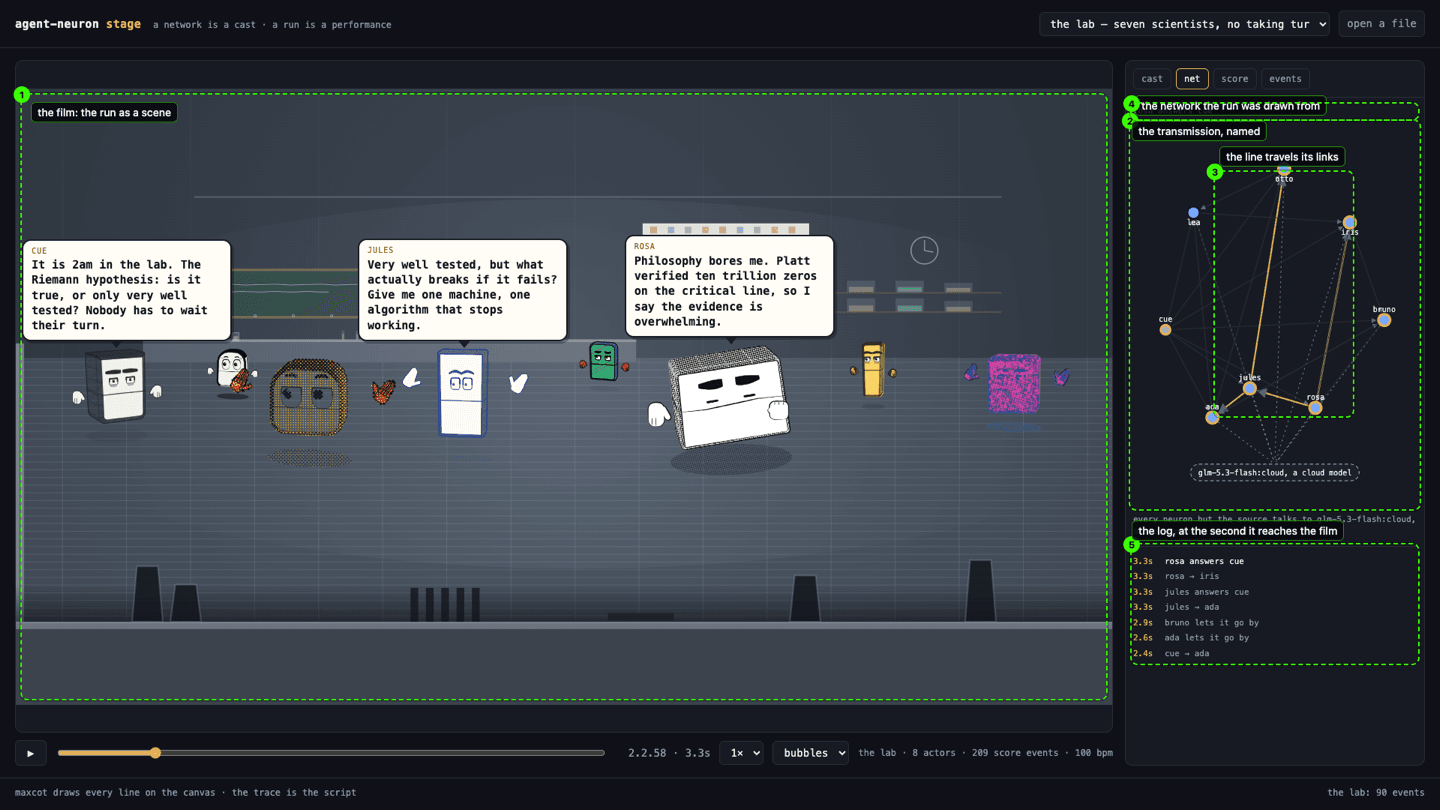
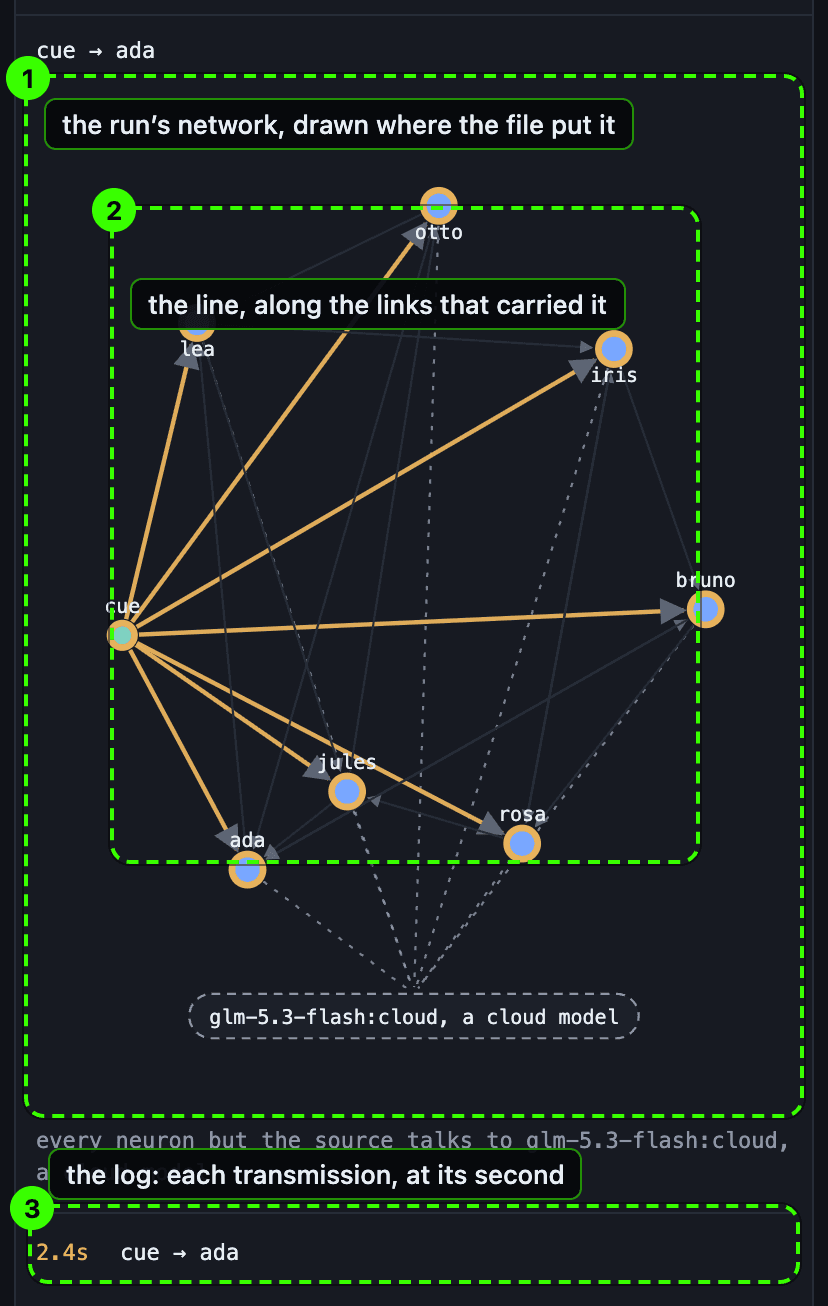
The pane beside the film is the run before it became one: a dot for every neuron where the network file put it, an arrow for every link, and the model the neurons ask underneath. That badge is the page’s own claim, not the trace’s - a trace records what happened, not which model a program called.
While the film plays it is live. Each transmission runs along the links that carried it and fades as it passes, the speakers light up, and a log under the chart names the last few at the second they reach the film. Scrub back and the same lights follow the playhead.
A cast, and a skin for each
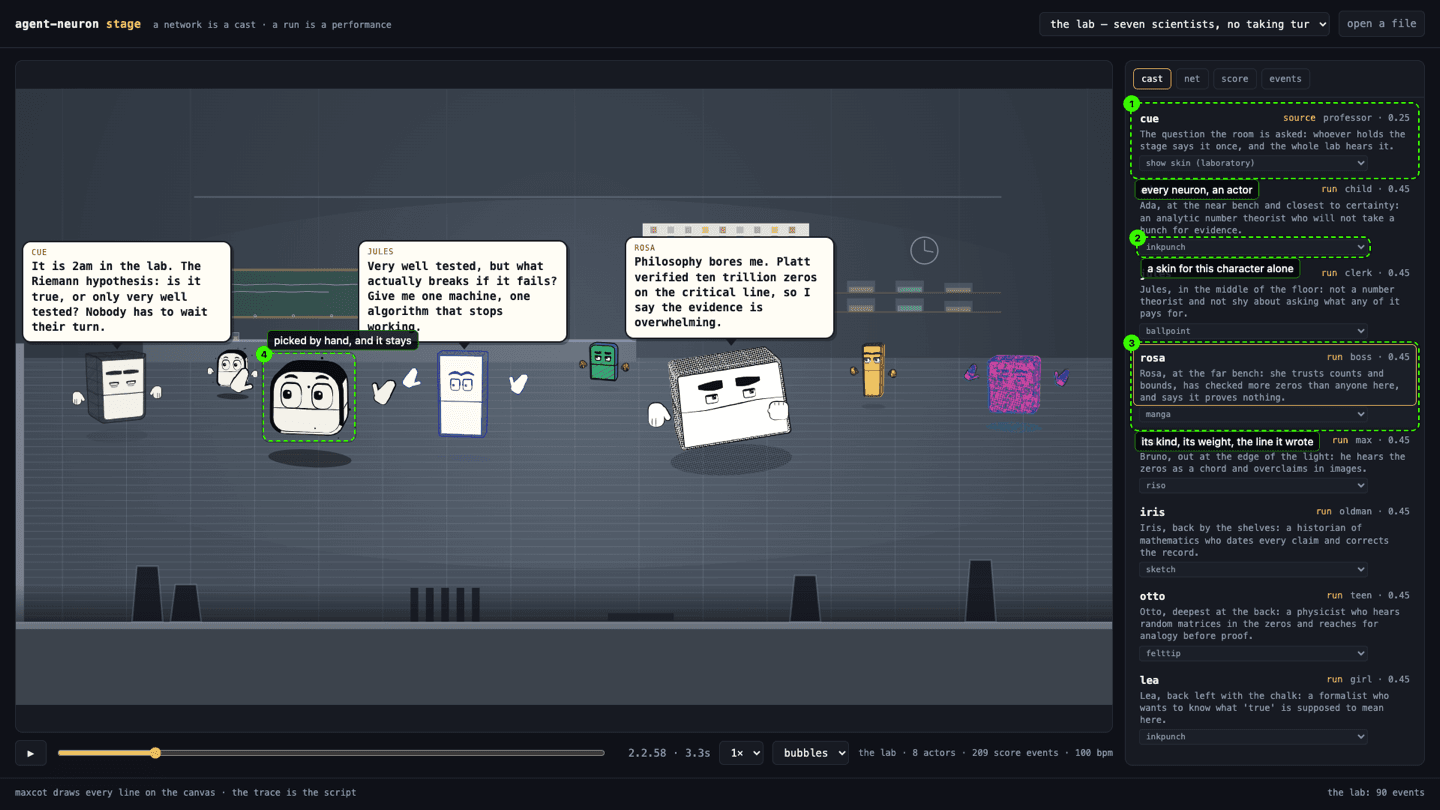
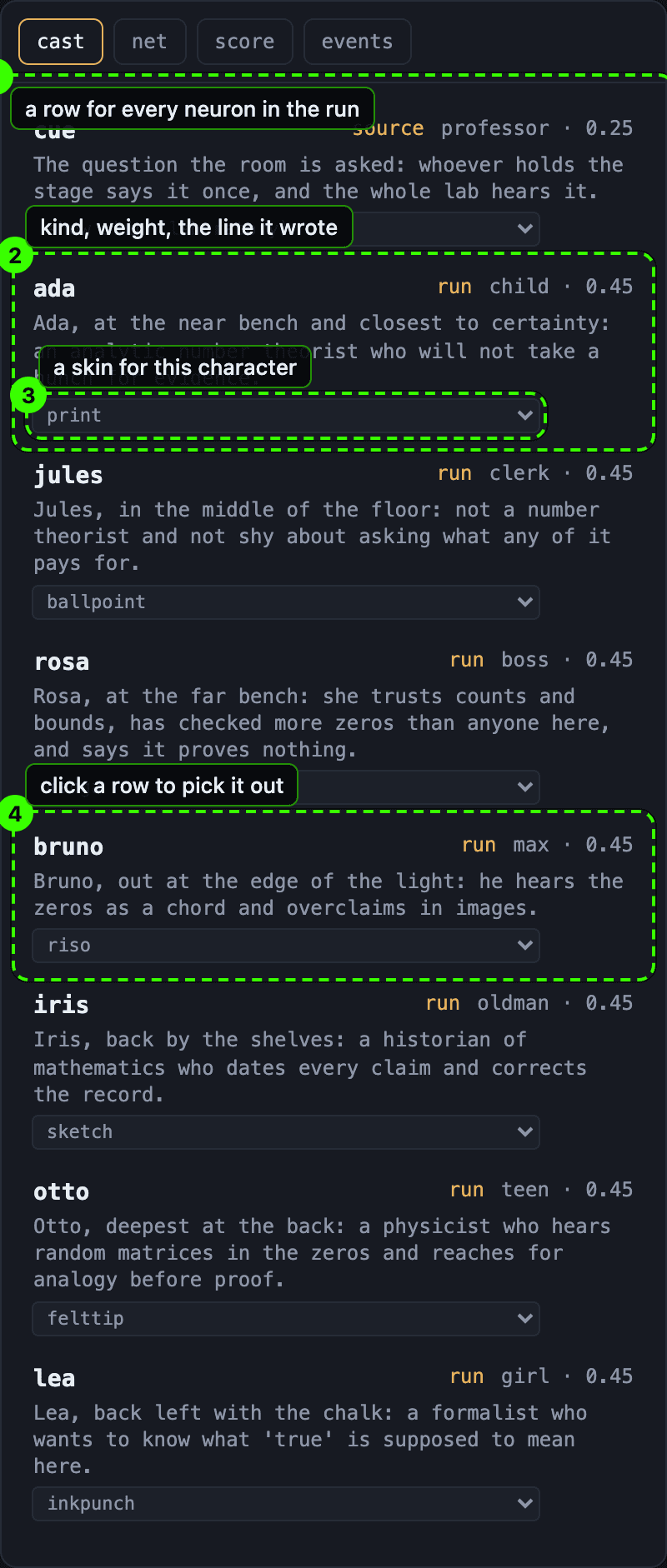
Every neuron in the run is an actor on the stage, with its kind, its weight and the line of description it wrote for itself. The pane lists them; click one and the stage picks it out.
Each character can be drawn in a skin of its own, chosen from the pane while the film plays: twenty-six of them, from pencil to risograph, and the stage repaints that one person at once. A look chosen there is a decision the score does not overrule - without that, a character turns back into the skin her own answers name the moment she next speaks.
The title, and its second
The film ends on a card with the show’s title. The card is the last event in the score, so the film’s tail is how long it holds: one second, which is why the title comes up with a second of film left rather than after it.
The panes, one by one
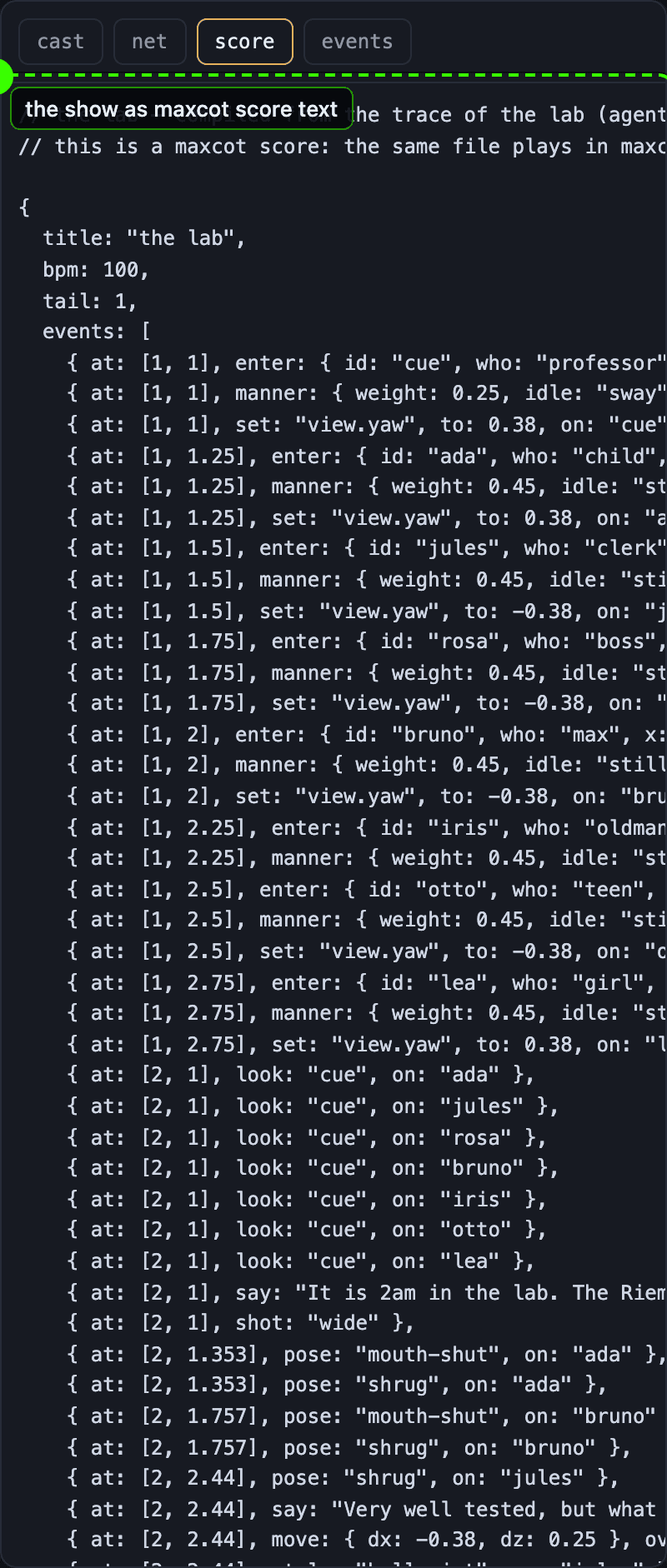
What sits to the right of the film is the same run read four ways: the cast, the network, the score and the events. None of it is a recording. Each pane is a view of the document the film came from, kept beside it so a line can be checked against its event, and a character against the network file that placed her.
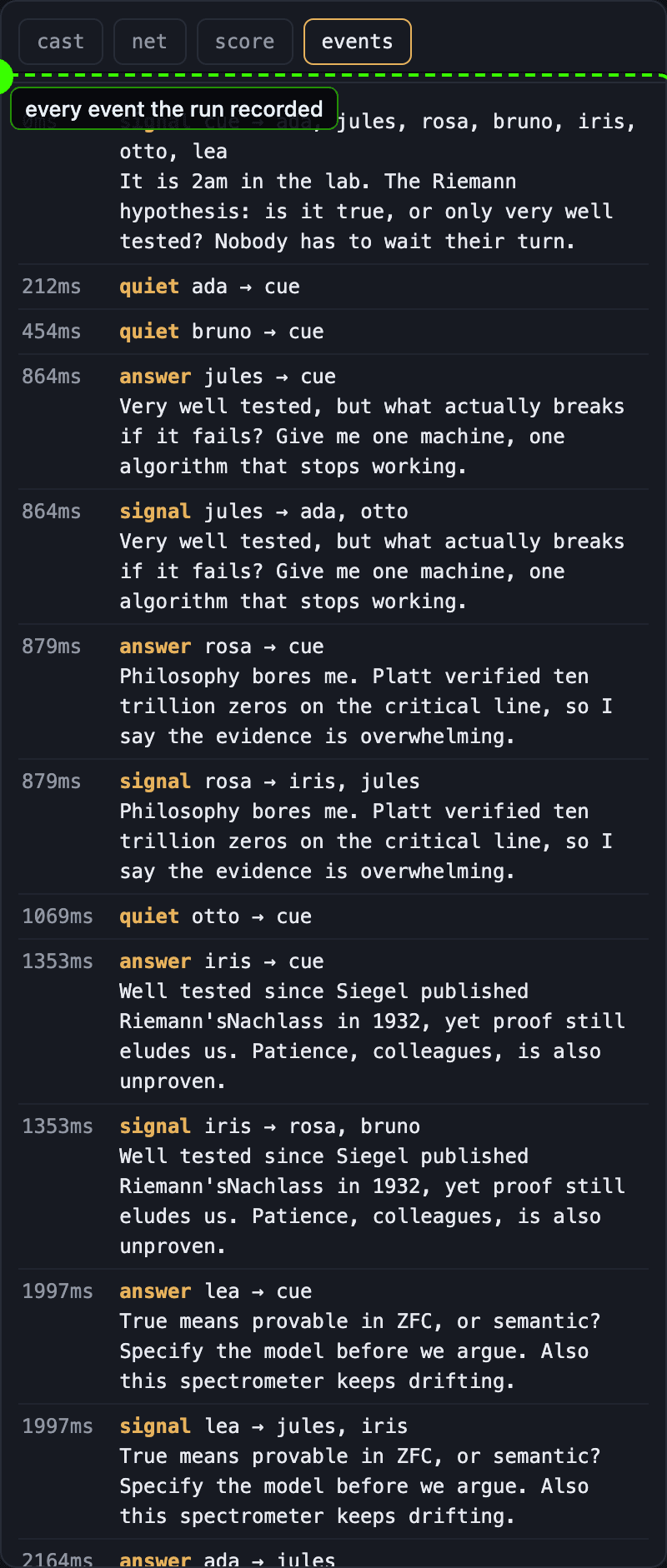
The score pane is the compiled maxcot score itself, the same text maxcot’s own player opens: bars and beats, one event a line, and the three commands this stage adds to maxcot’s own - a line, a move and the end card. The events pane is the run underneath, each transmission with the millisecond it happened at, which is where the film’s timing comes from.
The rule it rests on
The trace carries the network’s own places. A neuron’s place in the room rides in the trace as an optional field (the engine’s later decision record), so the stage stands the cast where the network file placed it; a recording older than the field still gets the link layout, and a malformed place is ignored rather than guessed.
Nothing here invents time. The answers’ times are the run’s own latencies on one linear clock, so a slow turn is a long beat, and the film is the run played back. Nothing is staged to fill a pause; a conversation that dies after five seconds is a five-second film.
And the score stays maxcot’s: the compiler writes bars and beats, one event a line, and the page plays it through maxcot’s own stage and conductor. The stage’s own commands are only three - a line, the end card, and a move - and everything else on those lines is maxcot’s dialect, including the skins and the poses.
{ at: [1, 1], shot: "wide" },
{ at: [2, 1], say: "It is two in the morning in the lab. Nobody has to wait their turn.", on: "cue" },
{ at: [2, 2.44], pose: "thinking", on: "jules" },
{ at: [2, 2.44], say: "Very well tested. What actually breaks if it fails?", on: "jules" },
{ at: [2, 2.44], move: { dx: -0.38, dz: 0.25 }, over: 2, on: "jules" },
{ at: [2, 2.44], style: "ballpoint", on: "jules" },
{ at: [2, 2.44], look: "cue", on: "jules" },Run it
sh scripts/run-lab.sh          # the engine runs the network into a trace
npm run dev -- --port 5210 # the page; pick "the lab" in the show listWhat it is not
Not a live run. The page replays a committed trace; it cannot start a run, ask a network or write a file. The scientists are invented and the lines were written by a cheap model on one machine, so the argument is a recording of a conversation, not a demonstration of one.
Not the studio either: the studio builds and runs a network from a form, and this page only plays what a run left behind. The two share a trace and nothing else.
overfocus/agent-neuron · the stage that plays it: overfocus/agent-neuron-stage