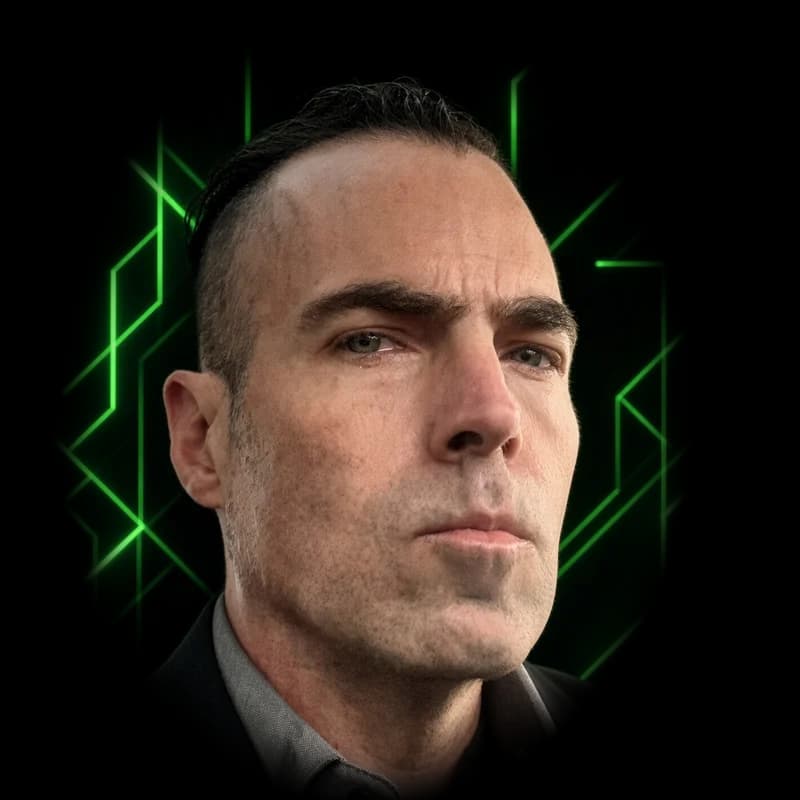
A discography film
Doug Martsch
A punk from Twin Falls who went to Seattle and came home, made a record three times, wanted no hits, and kept changing the band around him: twelve albums under four names.
Scroll to play the film. The pictures are made of dots: move over them, and play a sample to see them move with the music.
1969–1990
From Twin Falls to Seattle
Douglas Martsch was born on September 16, 1969, in Twin Falls, Idaho, and grew up mostly there. He loved the Pixies and the Replacements and the post-punk of the day: “There was always the idea that regular people making music didn’t have to be good, as long as you had good ideas.” His first band, Farm Days, had Andy Capps and Brett Nelson in it, two names that come back later.
After high school he joined three older players from the Boise hardcore band State of Confusion, Scott Schmaljohn, his brother Pat Brown and the drummer Wayne Flower, and in 1988 they formed Treepeople. In 1989 they moved to Seattle. Martsch didn’t care much for grunge, but the band fell in with several scenes, from Capitol Hill’s Squid Row to punk shows in Bremerton.
- At a garage party in Bremerton in their first week or two in Seattle, straight-edge kids who had got hold of the band’s demo tape sang along to their songs.
- His high, thin voice sounds like Neil Young, but he says he modelled it on J Mascis.
- In high school he thought, and sort of hoped, he would become a graphic artist.
Sources: Wikipedia: Doug Martsch, Wikipedia: Treepeople, Seattle Times 2018, No Depression 2002. Photo: Christina Birkinbine, Treefort Music Fest, CC BY 2.0.
1991
Guilt Regret Embarrassment
Treepeople · Toxic Shock Records and K Records
“Too many doubts have crossed my mind”
Treepeople’s second album was the last made by all four founders. “It was all written when we moved to Seattle and we were practising like crazy,” Martsch said. “To me that’s Treepeople.” The band hoped its Sub Pop connections would lead to a deal, but the label passed, and after Flower left later in 1991 they signed with C/Z Records for Something Vicious for Tomorrow and Just Kidding.
Homesick and tired of the road, Martsch went back to Boise after three years, to his girlfriend Karena Youtz, and began writing songs he thought would be Treepeople songs. He knew he was finished in the band when he heard they were auditioning other guitarists. Treepeople made one more album without him and broke up in 1994.
- “I definitely think it was our best record,” Martsch said in 2018.
- Pat Brown died in April 1999. Martsch wrote “Pat”, on There Is No Enemy, for him.
- The founders got back together in 2018, with Troy Wright on bass, after Flower made a now-or-never call fearing for his health. Their last tour ended in August 2023.
Sources: Wikipedia: Treepeople, Seattle Times 2018, No Depression 2002, LRCLIB. Sample: a 30-second preview from Apple Music.
May 1, 1993
Ultimate Alternative Wavers
Built to Spill · C/Z Records · produced by Built to Spill and Todd Dunnigan at Audio Lab, Boise
“I see me three years ago today”
Martsch formed Built to Spill in Boise in 1992 with Brett Netson of the space-rock band Caustic Resin and the drummer Ralf Youtz, and they recorded the would-be Treepeople songs that autumn. He told Spin that he meant to change the line-up for every album, with himself the only permanent member. The name came from a phrase invented in a game like exquisite corpse that he played with his wife.
The first line-up lasted only a few shows. Through the band’s early years Martsch worked day jobs, tending bar and mowing lawns, and the family lived in a trailer.
- “Nowhere Nothin’ Fuckup” is named after a song by Jason Taverner, the hero of Philip K. Dick’s Flow My Tears, the Policeman Said. Its words borrow heavily from the Velvet Underground’s “Oh! Sweet Nuthin’”.
- “Shameful Dread” samples dialogue from the Simpsons episode “Marge Gets a Job”.
- The record ends with “Built Too Long”, nine minutes in three parts, which samples Public Enemy’s “Rebel Without a Pause”.
Sources: Wikipedia: Ultimate Alternative Wavers, Wikipedia: Built to Spill, No Depression 2002, LRCLIB. Sample: a 30-second preview from Apple Music.
June 24, 1994
God Don’t Make No Junk
The Halo Benders · K Records · produced by Steve Fisk at Dub Narcotic
“God don’t make no junk”
In 1994 Martsch started a side project with Calvin Johnson of Beat Happening, the founder of K Records in Olympia, with Ralf Youtz on drums. Johnson’s baritone and Martsch’s high voice are so far apart that, as one description put it, “each seems to inhabit a completely different song.” Trouser Press called the album “a sampler of extraordinary diversity” and “a stack of strange gems”.
The Halo Benders made two more albums for K, Don’t Tell Me Now in 1996 and The Rebels Not In in 1998, the last produced by Phil Ek and more polished than the first two. They came back for a pair of shows in Boise in 2007 and a benefit in Olympia in 2010.
- The title refers to the black pride slogan of the 1970s.
- Spin put it on its list of “Rock’s 25 Greatest Team-ups”.
- Touring Utah in the 1990s, the band were pulled over by police officers who were being filmed for Real Stories of the Highway Patrol.
- Pitchfork ranked The Rebels Not In’s “Virginia Reel Around the Fountain” No. 188 in its top 200 tracks of the 1990s.
Sources: Wikipedia: God Don’t Make No Junk, Wikipedia: The Halo Benders, Wikipedia: The Rebels Not In, No Depression 2002, LRCLIB. Sample: a 30-second preview from Apple Music.
September 13, 1994
There’s Nothing Wrong with Love
Built to Spill · Up Records · produced by Phil Ek at John & Stu’s, Seattle
“I wanna see the movies of my dreams”
For the second album Martsch brought in his junior high friend Brett Nelson on bass and Andy Capps on drums, both from Farm Days. The songs hang loosely together around growing up: playing seven-up with a grade-school crush, a stepfather who looks like David Bowie (made up), a town called Twin Falls. Karena Youtz is in several of them. “Reasons” is a love song to her, and “Cleo” is sung from the point of view of their child in her womb.
“That was the last record when I was able to make music without thinking a lot of people would hear it,” Martsch said later. The band played Lollapalooza in 1995, and that year Warner Bros. signed them to a three-album deal that left Martsch a large degree of creative control.
- The video for “In the Morning” was shown on Beavis and Butt-head.
- An unlisted last track is a spoof preview of the next Built to Spill album. None of the clips in it are real Built to Spill songs.
- Pitchfork ranked it No. 24 in its top 100 albums of the 1990s. It is the only album with Andy Capps on drums.
Sources: Wikipedia: There’s Nothing Wrong with Love, Wikipedia: Built to Spill, No Depression 2002, LRCLIB. Sample: a 30-second preview from Apple Music.
January 28, 1997
Perfect from Now On
Built to Spill · Warner Bros. · produced by Phil Ek at Avast! Recording, Seattle
“I’m gonna be perfect from now on”
Martsch signed with Warner because it gave health insurance to his family, including his newborn son. Then he made the songs long on purpose, seven of the eight running past six minutes, so radio would leave them alone. “I didn’t want us to have a hit,” he said. “I was a little nervous that we might accidentally have a hit, and that our music would be shoved into people’s faces.”
The album was recorded three times. On the first try Martsch played everything but the drums, and only “Made-Up Dreams” survived. The second, with Nelson and the former Spinanes drummer Scott Plouf, was ruined when the tapes were left in Ek’s pickup truck and the heat got to them. The two failed versions cost $20,000, and it was Calvin Johnson who talked Martsch into trying again. By the time of the tour he could barely bring himself to play the songs.
- Built to Spill were the first band from Boise to put out a major-label album since the Fabulous Chancellors signed to Dot Records in 1963.
- “It was definitely the first time I thought there was going to be an audience for my music,” Martsch told Magnet.
- Pitchfork ranked it No. 22 in its top 100 albums of the 1990s. In 2008 the band toured it, playing the whole album each night.
Sources: Wikipedia: Perfect from Now On, Wikipedia: Built to Spill, Pitchfork 2018, No Depression 2002, LRCLIB. Sample: a 30-second preview from Apple Music.
February 2, 1999
Keep It Like a Secret
Built to Spill · Warner Bros. and Up · produced by Phil Ek and Doug Martsch at Bear Creek, Woodinville, and Avast!, Seattle
“Didn’t add up / Forgot to carry a zero”
Burned out on building long songs, Martsch set out to write short ones. Many began in a week of jam sessions in Boise that ran up to five hours at a time, with a foot pedal that started a tape machine; afterwards he combed the hours of tape for parts he liked and built them into songs. Nelson and Plouf were now permanent members, partly because it was easier than teaching new players the old songs.
Stephen Thomas Erlewine called it “the most immediate and, yes, accessible Built to Spill record.” It debuted at No. 120 on the Billboard 200, the band’s first real commercial success, and had sold 60,000 copies a year later. A live album followed in 2000.
- The verses of “You Were Right” are a collage of famous lines from the Rolling Stones, the Doors, Bob Dylan, Bob Marley, Kansas, Bob Seger, Pink Floyd and others. “I knew immediately that it was going to be a bunch of clichés,” Martsch said, “and I decided to use other people’s clichés.”
- The song nearly missed the album over copyright, until Warner got permission at the last minute.
- Pitchfork ranked it No. 41 in its top albums of the 1990s, the year it came out.
Sources: Wikipedia: Keep It Like a Secret, Wikipedia: Built to Spill, No Depression 2002, LRCLIB. Sample: a 30-second preview from Apple Music.
July 10, 2001
Ancient Melodies of the Future
Built to Spill · Warner Bros. · produced by Phil Ek and Doug Martsch at Bear Creek, Avast! and the Manhouse, Boise
“This strange sound you said I said”
The same trio made the fifth album, finishing it partly in the Manhouse, the studio behind Martsch’s house in Boise. It keeps to simple pop shapes. Pitchfork heard the closest thing to There’s Nothing Wrong with Love since 1994, with the sprawl of the Warner records cut away, and No Depression heard in it the country blues and plain playing of the solo album Martsch had already made.
Sam Coomes of Quasi plays keyboards, and opens “Strange” on the Rocksichord, his trademark instrument. By 2001 the band’s three Warner albums had sold 200,000 copies between them in the US.
- It reached No. 94 on the Billboard 200.
- Pitchfork reviewed it on its release day and called its songs “beautiful, unencumbered, unpretentious melodies”.
- Brett Netson, the band’s first bassist, plays guitar on four songs and thumb piano on “In Your Mind”.
Sources: Wikipedia: Ancient Melodies of the Future, Wikipedia: Built to Spill, Pitchfork 2001, No Depression 2002, LRCLIB. Sample: a 30-second preview from Apple Music.
September 2002
Now You Know
Doug Martsch, solo · Warner Bros. · recorded by Martsch at the Manhouse, Boise, from autumn 1999 to spring 2000
“She could just sell you things you couldn’t use”
Before he made it, Martsch had been listening to old country blues and folk he checked out of the Boise library, Harry Smith’s Anthology of American Folk Music and above all Mississippi Fred McDowell. “I took his tools, and his ideals,” he said. “All I did was put picks on my fingers and use my slide guitar, but play my own thing.” At first he thought the result “sounded crappy, and seemed sort of cheap and stupid”, until friends heard copies and liked it.
He wanted it out on Up. Warner would not let it go, and for a long while would not put it out either. Then the O Brother, Where Art Thou? soundtrack became a hit, and the label saw a link. “I’m sure the success of O Brother had something to do with it,” Martsch said, “but I’m not a fan of that at all.” It came out three years after he made it.
- The centrepiece is McDowell’s “Woke Up This Morning (With My Mind on Jesus)”, uncredited on the sleeve.
- Pitchfork called it “Blooze for Dummies”. Rolling Stone said it recalled O Brother more than anything by Built to Spill.
- The Manhouse was named by his son Ben at the age of two. Martsch called it “sort of a family clubhouse … It’s where our television is.”
Sources: Wikipedia: Now You Know, No Depression 2002, LRCLIB. Sample: a 30-second preview from Apple Music.
April 11, 2006
You in Reverse
Built to Spill · Warner Bros. · produced by Jacob Hall and Steven Wray Lobdell at Audible Alchemy, Portland
“When I was a kid I saw a light”
Built to Spill toured from 2003 to 2005, more than 150 dates, playing new songs as early as 2004. They recorded them in Portland in 2004 as a quartet for the first time, with the touring guitarist Jim Roth made a member. It was the first album since the debut without Phil Ek, and Pitchfork heard the band “casting off the usual meticulous guitar overdubs and studio polish in favor of a less refined, more spontaneous approach.”
It came out two years later, in a hard spring. In March Martsch had surgery for a detached retina and the band missed South by Southwest. On May 18 Andy Capps, the drummer on There’s Nothing Wrong with Love, was found dead at his home. When the tour resumed in June the band dedicated “Car” to him.
- “Goin’ Against Your Mind”, the first single, is nearly nine minutes long.
- In 2007 the band put out a 12-inch of the reggae-flavoured “They Got Away” and a cover of the Gladiators’ “Re-Arrange”. In 2002 Martsch had said he was listening to a lot of reggae.
- It holds a Metacritic score of 81.
Sources: Wikipedia: You in Reverse, Wikipedia: Built to Spill, Pitchfork 2006, No Depression 2002, LRCLIB. Sample: a 30-second preview from Apple Music.
October 6, 2009
There Is No Enemy
Built to Spill · Warner Bros. and ATP Recordings · produced by Dave Trumfio and Doug Martsch, recorded in Los Angeles
“Hindsight’s giving me / Too much memory”
Martsch had always told interviewers that his lyrics carried no personal meaning. Pitchfork’s Jayson Greene heard this one “singing convincingly from the perspective of someone thoroughly humbled by loss”, and called it “an improbable late-career reawakening”. The only clue to the loss is “Pat”, two and a half minutes of anger for Pat Brown of Treepeople, with Scott Schmaljohn, Pat’s brother, on guitar.
It was the last record with Nelson and Plouf. Guests include Sam Coomes, the cellist John McMahon and Paul Leary, and there are horns, and on “Things Fall Apart” a mariachi trumpet.
- Bob Odenkirk directed the 2010 video for “Hindsight”, the first single.
- In 2010 the band played the All Tomorrow’s Parties festival curated by Matt Groening.
- The UK and European edition on ATP added an unreleased song, “Water Sleepers”.
Sources: Wikipedia: There Is No Enemy, Wikipedia: Built to Spill, Wikipedia: Treepeople, Pitchfork 2009, LRCLIB. Sample: a 30-second preview from Apple Music.
April 18, 2015
Untethered Moon
Built to Spill · Warner Bros. · produced by Sam Coomes and Doug Martsch
“Being a human / Being an animal too”
“In 2012, I was a bit burned out on my ability to make new music,” Martsch said. “We actually recorded an album that year, and then we went on tour. The rhythm section guys quit the band, so we started over … it actually felt really good to start fresh.” In January 2013 he announced that Jason Albertini and Steve Gere were replacing Nelson and Plouf, who left on good terms.
He made the new album as a trio with them. It came out on vinyl for Record Store Day, almost six years after There Is No Enemy, the longest gap yet. In Exclaim!, Cam Lindsay called it “arguably the most enjoyable Built to Spill album since 1999’s pivotal Keep It Like a Secret.”
- Speaking to Pitchfork in 2013, Martsch said: “It’s hard getting older, thinking maybe I’ve run my course.”
- On the opening song, “All Our Songs”, Martsch sings that “rock and roll will be here forever”.
- Netson and Roth left later in 2015, and the band went on as a trio.
Sources: Wikipedia: Untethered Moon, Wikipedia: Built to Spill, Pitchfork 2015, LRCLIB. Sample: a 30-second preview from Apple Music.
2016–2019
A new band every time
In September 2017 Built to Spill left Warner Bros. after 22 years, and in October 2018 Martsch went back to his first idea: a rotating cast of players for each record. On the band’s first tour of Brazil that year, he needed a rhythm section and found João Casaes and Lê Almeida of the psychedelic band Oruã. Despite the language barrier they clicked, toured the US together in 2019 and recorded new songs in Boise.
In 2019 Melanie Radford came in on bass and Teresa Esguerra on drums. “I never have a set idea in my mind of what music should be or what Built to Spill should be,” Martsch said. “For the most part, everyone I’ve ever played with has done their own thing.”
- Treepeople’s reunion opened at Treefort in Boise in March 2018, then played Seattle, where the second night was sold out.
- Martsch’s creative bursts come and go. “It used to scare me,” he said in 2018. “I’d be like, ‘Oh shoot I’m all done, I’m all used up or burned out.’ But I keep finding that I keep coming back to it.”
Sources: Wikipedia: Built to Spill, Seattle Times 2018, Beats Per Minute 2022. Photo: Rusty Rehl, Treefort Music Fest, CC BY 2.0.
June 12, 2020
Built to Spill Plays the Songs of Daniel Johnston
Ernest Jenning · recorded by Jim Roth at Fort Lawton, Seattle, in 2018
“She fell asleep with the TV on”
In 2017 Daniel Johnston’s booking agent asked Built to Spill to back him, with the band’s 1994 cover of “Some Things Last a Long Time” in mind. They played his last two concerts that November; Martsch called them “good” and “weird”. Rehearsing, they recorded his songs for themselves and their friends, and in 2018, at a session at Jim Roth’s studio, they decided to make an album of them, with Albertini and Gere.
Johnston died on September 11, 2019, before it came out, and the pandemic pushed the release back from May to June. “The songs just rolled right out of him,” Martsch said. “I haven’t been able to make that a part of my own thing.”
- Looking back at the 1994 cover, Martsch said: “I think of that song as being so beautiful and delicate, and us just rockin’ it out like that … Like, what were we thinking?”
- Most of the eleven songs are ones Johnston recorded in the 1990s.
- The artwork is by Tae Won Yu, who also designed the sleeve of Ancient Melodies of the Future.
Sources: Wikipedia: Built to Spill Plays the Songs of Daniel Johnston, Wikipedia: Ancient Melodies of the Future, Pitchfork 2020, Beats Per Minute 2022, LRCLIB. Sample: a 30-second preview from Apple Music.
September 9, 2022
When the Wind Forgets Your Name
Built to Spill · Sub Pop · produced by Doug Martsch
“What could be more disorienting than being on acid in a dream?”
Casaes and Almeida recorded their parts in Boise at the end of 2019 and flew home to Brazil. Then the pandemic came, and Martsch finished the record alone on a computer, a way of working still new to him. “A lot of days, instead of making a record, I was looking on YouTube trying to troubleshoot to do some simple things in the program,” he said. His marriage to Karena Youtz, his co-lyricist since the early records, had ended.
Built to Spill signed to Sub Pop in October 2021. “I think I’m the first 50 year-old they’ve ever signed,” Martsch joked. Pitchfork called it “the first Built to Spill record in a while with new ideas”, made with a line-up that had already moved on by the time it came out.
- The cover is by Alex Graham, whose online comic Dog Biscuits Martsch followed during the pandemic. She didn’t know the band’s music when he asked her.
- In the video for “Fool’s Gold” Martsch appears clean-shaven in a bowl-cut wig, driving a convertible.
- It holds a Metacritic score of 81.
Sources: Wikipedia: When the Wind Forgets Your Name, Wikipedia: Built to Spill, Pitchfork 2022, Beats Per Minute 2022, LRCLIB. Sample: a 30-second preview from Apple Music.
2023 onwards
Nothing wrong, thirty years on
Built to Spill toured When the Wind Forgets Your Name through much of 2023, with Radford and Esguerra, and that August Treepeople played their last shows, in Boise, Portland, Seattle and Bellingham.
In 2024 the band toured There’s Nothing Wrong with Love for its 30th anniversary, playing the whole album every night from Boise on August 9 to Sacramento on September 29. John McMahon, who played cello on the original record, joined them on stage.
- Modest Mouse and Death Cab for Cutie are among the bands said to have learned from Built to Spill.
- Martsch still plays down his own playing. “I’m not very good at guitar playing,” he said in 2022.
Sources: Wikipedia: Built to Spill, Wikipedia: Treepeople, Pitchfork 2024, Pitchfork 2022. Photo: DiskoDieter, CC BY-SA 4.0.
Sources
- Wikipedia: Doug Martsch · Wikipedia, "Doug Martsch"
- Wikipedia: Built to Spill · Wikipedia, "Built to Spill"
- Wikipedia: Treepeople · Wikipedia, "Treepeople"
- Wikipedia: The Halo Benders · Wikipedia, "The Halo Benders"
- Wikipedia: Ultimate Alternative Wavers · Wikipedia, "Ultimate Alternative Wavers"
- Wikipedia: God Don’t Make No Junk · Wikipedia, "God Don't Make No Junk"
- Wikipedia: The Rebels Not In · Wikipedia, "The Rebels Not In"
- Wikipedia: There’s Nothing Wrong with Love · Wikipedia, "There's Nothing Wrong with Love"
- Wikipedia: Perfect from Now On · Wikipedia, "Perfect from Now On"
- Wikipedia: Keep It Like a Secret · Wikipedia, "Keep It Like a Secret"
- Wikipedia: Ancient Melodies of the Future · Wikipedia, "Ancient Melodies of the Future"
- Wikipedia: Now You Know · Wikipedia, "Now You Know (album)"
- Wikipedia: You in Reverse · Wikipedia, "You in Reverse"
- Wikipedia: There Is No Enemy · Wikipedia, "There Is No Enemy"
- Wikipedia: Untethered Moon · Wikipedia, "Untethered Moon"
- Wikipedia: Built to Spill Plays the Songs of Daniel Johnston · Wikipedia, "Built to Spill Plays the Songs of Daniel Johnston"
- Wikipedia: When the Wind Forgets Your Name · Wikipedia, "When the Wind Forgets Your Name"
- Seattle Times 2018 · Michael Rietmulder, "Built to Spill’s Doug Martsch reunites with Seattle punk greats Treepeople", The Seattle Times, March 15, 2018
- No Depression 2002 · Allison Stewart, "Doug Martsch: You gotta move", No Depression, September 2002 (two pages)
- Pitchfork 2001 · Pitchfork, review of Ancient Melodies of the Future, July 10, 2001
- Pitchfork 2006 · Matt LeMay, review of You in Reverse, Pitchfork, April 9, 2006
- Pitchfork 2009 · Jayson Greene, review of There Is No Enemy, Pitchfork, October 5, 2009
- Pitchfork 2015 · Jayson Greene, review of Untethered Moon, Pitchfork, April 21, 2015
- Pitchfork 2018 · Steve Kandell, Sunday Review of Perfect from Now On, Pitchfork, April 29, 2018
- Pitchfork 2020 · Jayson Greene, review of Built to Spill Plays the Songs of Daniel Johnston, Pitchfork, June 13, 2020
- Pitchfork 2022 · Evan Rytlewski, review of When the Wind Forgets Your Name, Pitchfork, September 19, 2022
- Pitchfork 2024 · Madison Bloom, "Built to Spill Announce There’s Nothing Wrong With Love 30th Anniversary Tour", Pitchfork, April 5, 2024
- Beats Per Minute 2022 · Jasper Willems, "Special in other ways: an interview with Built to Spill", Beats Per Minute, September 8, 2022
- LRCLIB · LRCLIB lyric database, for the exact wording of each quoted line